Big Bang Poetry

Reinventing the Life of a Poet in the Modern World

Page 59 of 69

W. H. Auden

AudenFor years I've had this W. H. Auden compliation and never opened it. Two weeks ago, I grabbed it for some humor, expert rhymes and musical lines. Auden is one of the first poets I became familiar with, assigned to report on him in my very first poetry class in high school. I did a short study of the two perinnials: "The Unknown Citizen" and "O Tell Me the Truth About Love." I was reminded of him again when "Funeral Blues" came up in Joan Dideon's recent book Blue Nights.

What I enjoyed about reading Auden this time were his takes on other writers and pop culture, all the times he dropped in celebrity names.  My least favorite poems were the love poems with the exceptions of "What's in Your Mind, My Dove, My Coney" and "Song" that begins with "You were a great Cunarder, I/Was only a fishing smack."

Celebrity culture is dealt with in "Who's Who" and he often references the famous: Mae West, Fred Astaire, John Gielgud, and Valentino in between his thoughts on war and Quantum Theory. "Imagine what the Duke of Ellington/Would say about the music of Duke Ellington." (from "Letter to Lord Byron")

There are always lovely rhythms in his lines. From "Foxtrot from a Play:"

"The soldier loves his rifle,
The scholar loves his books,
The farmer loves his horses,
The film star loves her looks…

And this refrain in the poem:

"Some lose their rest for gay Mae West,
But you're my cup of tea…

Some like a tough to treat 'em rough,
But you're my cup of tea…

And some I know have got B.O.
But you're my cup of tea…

Ending on:

And dogs love most an old lamp-post,
But you're my cup of tea.

I enjoyed wading through his long epic "Letter to Lord Byron" to see how he handled the extended celebrity poem. In the poem he mentions Gary Cooper, Jane Austin, Crawford and 'Mr. Yates' among others.

I loved how he takes the piss out of advertising in "Ode" going deep into the selling and being-sold-to psyche: 

"Though I know that the Self's an illusion,
And that words leave us all in the dark,
That we're all serious mental cases
If we think that we think that we know."

"The Truest Poetry is the Most Feigning" is a great discussion of the politics of word choice. More on writers ("the snivelling sonneteer") and healers:

"The friends of the born nurse
are always getting worse."
–"Shorts"

"Every brilliant doctor
Hides a murderer."
–"Many Happy Returns"

"The average poet by comparison
Is unobservant, immature, and lazy.
You must admit, when all is said and done,
His sense of other people's very hazy,
His moral judgements are too often crazy,
A slick and easy genereralisation
Appeals too well to his imagination."
–"Letter to Lord Byron"

"It may be D.H. Lawrence hocus-pocus,
But I prefer a room that's got a focus."
–"Letter to Lord Byron"

"Joyces are firm and there there's nothing new,
Eliots have heardened  just a point or two.
Hopkins are brisk, thanks to some recent boosts.
There's been some further weakening in Prousts.

I'm saying this to tell you who's the rage,
And not to loose a sneer from my interior.
Because there's snobbery in every age,
Because some names are loved by the superior,
It does not follow that they're the least inferior…
–"Letter to Lord Byron"

There were also many more references to sex and the dramas of sex than I expected. Auden is very saucy.

"When Laura lay on her ledger side
And nicely threw her north cheek up,
How pleasing the plight of her promising grove
And how rich the random I reached with a rise."
–"Three Songs from The Age of Anxiety"

But he was a curmudgeon in the end. From "Doggerel by a Senior Citizen:"

"The Speech was mannerly, an Art,
Like learning not to belch or fart:
I cannot settle which is worse,
The Anti-Novel or Free Verse."

Ah…those crazy gadgets kids are into: free verse poems!


Free eBook Weekend!

500x800Free eBook weekend on Smashwords!

My first eBook promotion!
Get the goods while you can!

February 1-3 (Friday through Saturday)

Steps

  1. Visit: http://www.smashwords.com/books/view/247571
  2. Add the book to your cart
  3. Enter the code in the coupon code field: NA62N
  4. Tell me all about it! 

About the book:

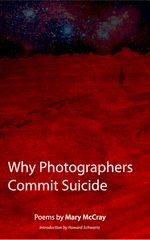
Why Photographers Commit Suicide explores, in small narratives and lyrical poems, the American idea of Manifest Destiny, particularly as it relates to the next frontier—space exploration. Mary McCray examines the scientific, psychological and spiritual frontiers enmeshed in our very human longing for space, including our dream of a space station on Mars. These poems survey what we gain and what we lose as we progress towards tomorrow, and how we can begin to understand the universal melancholy we seem to cherish for what we leave behind, the lives we have already lived. McCray unearths our feelings about what it means to move ahead and stake out new territory, and what it means to be home.  


Join the Newsletter

NewsThis week the first quarterly Big Bang Newsletter is going out. The newsletter has summaries of all the season's articles and web updates, the best comments and a list of books and apps reviewed.

The newsletter also includes a secret book marketing tip or two not included in the blog!

Join now! It's free!


The Top 15 Joys of Physical Books With Which eBooks Cannot Compete

Book

My anthropologist husband, Mr. Bang Bang, said to me this weekend, "Culture is always changing. That is, in fact, the definition of culture. If it never changed, we wouldn't even have books."

So if you hate the inevitable march of culture (and it's eBooks), you have to forsake your beloved books as well.

I have come around to eBooks. Last year I published my own eBook campanion to Why Photgraphers Commit Suicide. You can't escape the reality that eBooks save trees, they save author's money (with bigger royalties due to lower production costs), and they save your customer both money and time (for example, if they need to download research material quickly for deadlines). In this brave new world, book-lovers will have categories of books they own: favorite books on a bookshelf and school books, research books or "books to take a chance on" for the mobile devices.

But as much as I appreciate the benefits of eBooks, there are still a few ways in which physical books rule:

  1. You can hallow out a book to sneak a gun into your lover who is in prison.
     
  2. Marooned in the cold wildnerness, you can use the pages of a book to start a fire and stay alive.
     
  3. You can read a book in a bathtub without the worry you will drop it into the water and subsiquently be out of a $300 phone.
     
  4. You can read a book on the beach without the fear it will be stolen from under your beach towel while you are tubing in the sea.
     
  5. Related to items #3 and #4, a book can survive water damage.
      
  6. With your physical book covers, you can impress other passengers on trains and plains. You're an intellectual, not a frivolous Draw Something gamer.
     
  7. You can become a connoisseur of the smell and feel of various book papers.
      
  8. You get to savor the delicious sound of flipping pages and spine bending.
     
  9. With paper, it's easier for Fascists to make a book burning look dramatic.
     
  10. It's harder for robbers to steal your entire library inadvertently while they are stealing your techie toys.
     
  11. You get to experience the feel of a pen as it rolls ink out to create your marginalia.
      
  12. You get the obsessive compulsive satisfaction of organizing and re-organizing your bookshelves to impress your house guests.
      
  13. Real books work in a pinch to steady lopsided dinner tables.
     
  14. Dog-earring.
      
  15. Best of all is the joy of unpacking after a move and pulling all your books out of boxes with delight in remembering long lost treasures you somehow forgot you had.


Social Media and Mobile Apps for Authors

SocialmediaJust finished the book Social Media and Mobile Apps for Authors by Gail Z. Martin.

If you're new to social media and need a short book to get your started, to explain why social media is important for you and to give you a quick overview of the major players (right now) in the social media arena, this is the book for you.

For more advanced social media users, this might only provide a short list of new tips and ideas.

I was hoping smartphone apps would be discussed at greater length than four pages at the back of the book, and then only the more general apps like DropBox, eFax and DragonDictation. You might find more information about the latest apps by searching Google for the term "best apps for poets."


My Haiku in Support of Stitching for Elephants

StichingMy friend Christine Horace started a  Crowdrise page to raise money for the David Sheldrick Wildlife Trust, an organization that rescues and rehabilitates orphaned (mainly due to poaching) elephants.

Donations go to the US Friends of the David Sheldrick Wildlife Trust to help support the rearing and rehabilitation of the orphans.

Visiting the orphanage was one of the highlights of her trip to Kenya where she learned that baby elephants can die from loneliness. The David Sheldrick Wildlife Trust provides a human and elephant family where the elephants can continue todevelop normally and one day return to the wild.

Christine also started a quilt blanket as part of "Stitching for Elephants." Blankets play an important role in the recovery and rehabilitation of orphaned elephants at David Sheldrick Wildlife Trust's nursery. More information: http://www.dswtwildernessjournal.com/orphans-in-blankets/

Christine's blanket is over half finished and she asked me to create a haiku to stitch into one of the panels.

Playing elephant:
ash-leaden baby feet for
rolling whirling Earth

Check out the project:

Richard Blanco & Poets at Inaugurations

Blanco-obamaSo the poet of the hour is Richard Blanco, the man who made a hit of himself during Monday's inauguration of President Obama.

When he came on to read "One Today," Mr. Bang Bang asked if that was Ben Stiller or Paul Ryan.

Poems for public occasions, especially big ceremonials like this, are tricky. You can't lay out an arty opus that will fly over the heads of folks in TVLand. You have to invoke the big ponds and rocks of America. You have to highlight Americans, like Blanco did with his repititions of faces and hands. You have to invoke plebeian things like cabs and groceries. The editor in me would have dispensed with the 7th stanza. There is much awkwardness in the mishmash of:

weaving steel into bridges, finishing one more report
for the boss on time, stitching another wound
or uniform

But there are plenty of good lines in there:

on our way to clean tables, read ledgers, or save lives–
to teach geometry, or ring-up groceries as my mother did
for twenty years, so I could write this poem.

…the impossible vocabulary of sorrow that won't explain
the empty desks of twenty children marked absent
today, and forever.

[a somber nod to the Newtown, Connecticut, shooting]

…hands gleaning coal or planting windmills
to deserts

[that would be invoking both of my particular great-grandfathers]

...the plum brush of dusk

Read the full poem.
Watch a video of Blanco reading the poem
.

The Daily Beast called the poem "Whitman-esque…a grand tour of the continent." William Wright of Southern Poetry Anthology called it "incantatory, an optimistic, careful piece meant to encourage, a balm."

Blanco's charge was probably to write about unity…in a multi-cultured way. I don't know how far he'll get bringing opposing sides of the Washington D.C. together however.  After all, only five poets have contributed to presidential inaugurations. And those five have all been invited by Democrats. Do Republicans even believe in global poetry-ing?

Blanco read his poem in that overly-serious poet cadence, as you do. After he finished, the massive crowd gave him some polite clappings (not the roaring ovation of Obama or even Beyonce) and Chuck Schumer (who I voted for by the way, years ago when he was first running and I was living in New York City) gave a slight indication of discomfort in the transition, as to say "Ok, now we did that. Moving on." I thought maybe Blanco didn't go over. But he did! People were talking about him on MSNBC and the next morning on The Stephanie Miller radio show and even my co-worker remarked about it. Turns out Blanco broke some records Monday and people were proud of him. Not only was he the youngest to have read a poem at an inauguration, he was the first immigrant, the first Hispanic and the first openly-gay poet to do so. Wow! The poet is office-cooler worthy conversation this week! What a great thing Richard Blanco did for us!

Blanco's poetry website is also very good. I'm excited when poet even has one! The site is very simple and the left-hand menu is full of action items to draw you in: Meet (interviews), Read (books), Listen (recordings), Look (press kit), Contact (all the major social media icons are represented). Blanco if anything might be just a little too slick. He's got a publicist, a speakers agency (Blue Flower Arts no less), and a manager! Blanco's website proved its own importance this week as various news stories culled quotes from it.

His Wikipedia page also peaked my interest to read his 2012 book Looking for the Gulf Motel, specifically the poem "Queer Theory: According to My Grandmother" with lines like:

Don't stare at The Six Million-Dollar Man
I've seen you.

The history of poets at presidential inaugurations

Robert Frost read "The Gift Outright" at John F. Kennedy's inauguration in 1961. It was not the poem he intended to read. "Dedication" was.

Frost

Maya Angelou read "On the Pulse of the Morning" at Bill Clinton's first inauguration in 1993. Poets spent much time hating on that poem although the event made her famous. Watch her read it at the inauguration; she's introduced as Maya Angelow.

Maya

Miller Williams read "Of History and Hope" at Bill Clinton's second inauguration in 1997. Bill Clinton makes the "listening carefully" pose.

Miller-clinton

Miller Williams is the father of acclaimed alt-country singer Lucinda Williams.

 Lucinda

Elizabeth Alexander read "Praise Song for the Day" for Obama's first inauguration in 2009. Watch her performance on video.

Alexander


3 Poetry Apps Reviewed

One of my goals this year is to explore poetry apps on my iPhone. There are many many many. Some are helpful and fun. Some are annoyingly boring and pointless.


JdPoets & Writers
(free) is one of the pointless ones. You can only manage your subscription with it, something it takes a simple website to do. Obviously P&W miss the point of why an app is worth having. No one will be using this non-tool (even subscribers) and so the advertising opportunity of luring in new subscribers with a free tool is missed. P&W should look to the business model of United Airlines and their app for an appreciation of how to make an app that is useful beyond your limited customer base but that will further your brand.

Poetry Daily (free) 
Pdis a very popular poetry-of-the-day site that has offered up a very easy to use app. I actually look forward to Poetry Daily's well-picked fare. My only issue with this app is that you cannot re-size the text to fit your screen. For poems with long lines you have to move your screen right then left for every single line. It's annoying. I give up on every poem wider than the size of my iPhone. This happens more than you'd think. User frustration is not what makers of apps want for their customers.

I've tried a few visual poetry apps for fun. They were of limited gaiety to be honest. The first was Visual Poet (free). Basically this poem just matches three photos of your choice with three lines of verse you enter. I can't see what use this would be beyond a haiku. To try it out, I created a visual poem from the first haiku in my 2004 book St. Lou Haiku. You can pick the photos from Tumblr, Flickr, Google or your camera and adjust the font size and positioning. Then you can email it.

ArchpoemCredits:

St. Lou Haiku
Mary Elizabeth Ladd &  Julie Wiskirchen
2004
Timberline Press
ISBN 0-944048-32-3
29 pages: 107 haiku/4 illustrations by Clarence Wolfshohl       
5.5×8.5/letterpress

The poem represented was composed by Julie Wiskirchen.


A similar program is called Visual Poetry (0.99). This app is slightly more fun in that it takes a line of poetry and creates some word art out of it. There are color and font choices and 18 art styles, which I felt was a limited amount. You can then email the art piece to your friends.

I tried something with the first line from my 2012 book Why Photographers Commit Suicide: "Imagine your life in a glass box."

ImagineCredits:

Why Photographers Commit Suicide
Mary McCray
2012
Trementina Books
ISBN 0985984503
87 pages/8 illustrations by Emi Villavicencio       
9×6/paperback and eBook


Of all three apps reviewed so far, I would probably only recommend Poetry Daily for repeated use, although I will keep watching Virtual Poetry and the new art opportunities for one liners.


Longfellow’s Guide to Writer’s Toil

LongfellowI guess he doesn't get much respect these days, Henry Wadsworth Longfellow. Although when most non-poets think of famous American poems, his greatest hits tend to crop up.

We never studied Longfellow in school but I'm a bit fond of the furry fellow. Years ago when visiting some family who had moved to the 'burbs of Boston, we would occasionally get a wintertime feast in the town of Sudbury at  The Wayside Inn, a place I absolutely loved because it was colonial-old and quietly writerly. Longfellow stayed there on occassion and published Tales of a Wayside Inn in 1863.

Their website explains it well:

Longfellow's Wayside Inn is proud to be the oldest operating Inn in the
country, offering comfort and hospitality to travelers along the Boston
Post Road since 1716.

How quaint is the horse-bound journey of the poet finding this inn like a port in a storm? Pretty f*ing quaint, I thought. Add to that an old timey dining room with some old timey vittles. You had me at words New England Oysters.

Years later I visited Plymouth and Concord Massachusetts with friends over Thanksgiving weekend and we made a trip to see not only Cranberry World but Longfellow's house, now a National Park Service site, near Harvard Square in Boston. Unfortunately it was closed for the holiday weekend but we did pick up some buttons offered in a box at the front gate, buttons with Longfellow's image and the declaration: "I'm a poet too!"

To this day, that is my favorite button.

So I have mixed feelings about Longfellow. Poets beat him up for being an imitator of the English Romantics. But…I have that button and he had good taste in motels. 

Also, while reading Hand of the Poet, I came across a poem that spoke to me as a toiler of verse. It was the poem "A Psalm of Life." You know, the one where he coined the term "footprints in the sands of time."

(By the way, what cliche have you coined lately?)

The poem goes as follows:

    TELL me not, in mournful numbers,

        Life is but an empty dream ! —

    For the soul is dead that slumbers,

        And things are not what they seem.

    Life is real !   Life is earnest!

        And the grave is not its goal ;

    Dust thou art, to dust returnest,

        Was not spoken of the soul.

    Not enjoyment, and not sorrow,

        Is our destined end or way ;

    But to act, that each to-morrow

        Find us farther than to-day.

    Art is long, and Time is fleeting,

        And our hearts, though stout and brave,

    Still, like muffled drums, are beating

        Funeral marches to the grave.

    In the world's broad field of battle,

        In the bivouac of Life,

    Be not like dumb, driven cattle !

        Be a hero in the strife !

    Trust no Future, howe'er pleasant !

        Let the dead Past bury its dead !

    Act,— act in the living Present !

        Heart within, and God o'erhead !

    Lives of great men all remind us

        We can make our lives sublime,

    And, departing, leave behind us

        Footprints on the sands of time ;

    Footprints, that perhaps another,

        Sailing o'er life's solemn main,

    A forlorn and shipwrecked brother,

        Seeing, shall take heart again.

    Let us, then, be up and doing,

        With a heart for any fate ;

    Still achieving, still pursuing,

        Learn to labor and to wait.

I guess it bears repeating:

  Let us, then, be up and doing,

        With a heart for any fate ;

    Still achieving, still pursuing,

        Learn to labor and to wait.

Think about that vis-à-vis your own life's efforts. I posted the following quote on my Facebook page last week after watching the documentary The War Room, a behind-the-scenes look at the campaign of Bill Clinton. After winning the election, James Carville, when congratulated for his successes in the campaign, gave this speech to his staff:

"There is a simple doctrine: outside of a
person's love, the most sacred thing that they can give is their labor.
And some how or another, along the way we tend to forget that. And labor
is a very precious thing that you have and anytime you can combine
labor with love, you've made a merger…people are gonna tell you you're
lucky. You're not. The harder you work, the luckier you get."

Growing up, I never believed it was honorable to be a writer. I thought it was a soft job, like being a philosopher or a politician. A thinker doesn't work. I believed that until the day I saw Mark Twain's typewriter in a museum in Hannibal, Missouri. In a single moment I realized writing is a physical act. Typing itself is labor. Writing is work.

Love the work and wait.

Take the virutal tour of Longfellow's house.


« Older posts Newer posts »

© 2026 Big Bang Poetry

Theme by Anders NorenUp ↑