Reinventing the Life of a Poet in the Modern World

Category: Whole Life of the Poet (Page 1 of 19)

DIY vs. A.I.

I’ve had many opportunities over the last few years to talk to other writers who are being required to use A.I. on the job or writers who are volunteering to A.I. as a pretty substantial writing shortcut, from that waiter at Dear Janes in Los Angeles using it to come up with teleplays to friends using it to start early screenplay drafts and editors and writers at consulting firms and magazines creating first drafts of think pieces.

I’ve noticed two things: people who love to write are annoyed and deeply discouraged by A.I. This feels like the end of the world for them.

But for the people who want to have written things but who don’t like the actual writing itself, they have found A.I. to be the solution to all their problems, especially the to become known as writers without actually writing anything. I know people like this, too. In many cases, they are a lazy and unimaginative group. And they now get to be writers because we will shortly cease to know the difference. We are already inundated by A.I. writing online. Right now, submitting to journals is based on an honor system (a check box where you declare you didn’t use A.I. to write your piece,  Scouts honor.) What a mess. Not only do editors have to worry about lies in cover letters, but now lies about the whole enchilada. (Mmmmm…enchiladas!)

Sure, there are many programs out there working to help teachers and readers detect these A.I.-generated things by telltale signs, but there are also services online at this moment available to help those lazy students, writers and artists outsmart those existing A.I. detectors.

And so around it goes and here we are.

And don’t get me started on errors of A.I., those “hallucinations” and fake attributions. For well documented things, like medical information, there seems to be a higher rate of accuracy with A.I.. But for things society cares less about, like who wrote what poems, A.I. is full of cuckoo claims.

Someone recently wrote to me asking for the provenance of a poem about Georgia O’Keeffe. Every prior spin with A.I. had led to a different poet author, one allegedly me. So I tried it myself by running larger and larger word sets of the poem through A.I. and sure enough the poem was attributed to different poets each time (never again me) and the results came with elaborate explications about what those writers supposidly meant. Further searches in plain old Google revealed that these writers did not write the poem (Mary Oliver for one example) and that the poem did not in fact live online at all (to be evaluated by A.I.)

So A.I., it turns out, is a big blowhard, at least concerning poetry.

Who wrote what now is a big sad, mystery, the truth of it between you and your God.

So if we weed out The Lazy and Unimaginative set, we are left with those of us who really do enjoy the craft of writing, creating things “from scratch.” And DIY is a huge thing in many areas so there are plenty of us in this happy group. The big crowd at the yearly Albuquerque zine festival told me that.

These are people for whom automation robs them of all the fun. I would argue for myself that solving problems in writing is all the fun: shuffling, rejiggering the sentences and words, trying to locate the real message. There are endless experiments I would miss, personally.

So if you’re the kind of person who is disheartened by A.I. writings, you may also be the kind of person who likes writing exercises.

Here’s one you can try. Keep all your drafts intact.

  1. Write a 25-line poem around one of these tangible things: shoes or cooking or trees.
  2. Get a Thesaurus and change about 6-8 words, a few nouns and a few verbs. Don’t touch the adjectives yet.
  3. Rewrite the poem making all short sentences long and all long sentences short.
  4. Locate all your adjectives. Throw them all out and replace half of those with new ones.
  5. Locate all your adverbs and replace them with inappropriate adverbs.
  6. Swap your first and last sentences.
  7. If you wrote about cooking, create a title that is about shoes or trees but still ties back somehow to cooking (even metaphorically). If you wrote about shoes, create a title that is about cooking or trees but still ties back somehow to shoes.  If you wrote a poem about trees, create a title that is about shoes or cooking but still connects to trees.
  8. Read all your 7 poems. Which one(s) do you like best and why. You may love your first draft best but you should know why and be able to articulate it.

I can’t say I never use A.I. to help me out of a search quandary. Google searches don’t always lead you to the right place. And we all have to pick and choose how to use A.I. or not use it. For someone for whom writing is a challenge, physically and mentally, I can see how A.I. could be a very helpful communication tool. But that’s understandably necessary communication work. I can also see how A.I. could save valuable time in science and technology: not having to “reinvent the wheel” every time. But I can’t see any benefits for art for which the struggle is a lot of the point.

There are a few things in this world that don’t need so much technological intervention, as poet Darby Hudson recently stated: “If the modern world makes you sick, remember–the heart is ancient and hasn’t had any updates.”

Tech Fails and The Malevolent Provocateur

I was in a team meeting  a few months ago and my boss noticed, apropos of nothing, that my name, Mary McCray, has, (eerily and evenly), two Ms, two As, two Rs, two Ys and two Cs. Like my whole name is a duplication of the letters M, A, R, Y and C.

And then he searched for annograms of my name and the one that best described this strange situation was “Marcy Marcy.” He jokingly found said this was probably messing up the matrix.

I said that sounds bad but just add it to the pile of all other things.

Sigh.

Breaking the Spiritual Matrix

I’ve been sitting on this post for months. Months! It felt too depressing to post. Not that I’m above (or below) posting gloomy. When the time calls for. Because I like a good grouse as much as anyone. But this one felt really complain-y.  And how useful was that?

It’s basically about all the tech fails happening all around us (and what this means for creative people). And I’m not just talking about new tech problems, like A.I. or the  occasional A.I. “hallucinations” although those are kind of batty when they happen. Asking A.I. to explain who Mary McCray is has been both fascinating and disturbing. For one thing, A.I. thinks more highly of me than I think is true. I had a book club meeting and we’re all writers so we talked about that and I’m convinced A.I. is trying to ingratiate itself by blowing smoke up our asses. And then just the wrongness. For example, A.I. had me co-writing a very famous song. And aside from helping my brother get out of a lyrical dead-end once every few years, I’ve never written a song in my life.

But I’m not talking about all that. I’m talking about tech things that have been working forever and suddenly they are not working…and nobody knows why or how to fix them anymore because systems and technology have become too complicated to unravel and fix. So the problems are left just languishing out there in the open like abandoned motels on the side of the road.

Wholesale things on websites, like links and redirects not working. Email confirmations not working. Phone apps not working. Virus scanners getting confused. Phone trees breaking down. My text app can’t handle group threads anymore. And it’s been broken for over a year. Business processes breaking the minds of the people and machines tasked with following them. It’s like we’re arriving at a tipping point where technology is doing more harm than good and people are dumping their “smart” appliances for “dumb” ones….just to be able to, for example, do their laundry.

The amount of phone apps we are required to have just to make hair and doctor’s appointments, get grocery store coupons. Not only are we having storage problems, but the elderly can’t fill out copious amounts of pre-visit online forms when they can’t understand the ten steps needed to access them.

A recent airline ticket QR code stopped working for me 30 minutes before a flight and the flight attendant has to print a ticket off for me. Like on that amazing technology of paper.

A doctor I’ve been trying to see finally cancelled my appointment this month because they can’t navigate my insurance situation. They tried for six months and finally we both gave up.

What a mess everything is.

And then there’s this thing they are calling a decline in our attention span. I call it becoming illiterate. Over the years, I’ve watched a very, very smart friend struggle with any kind of longform reading at work. When a long email comes to this person, they struggle with “too much information” and the bullying “wall of text.” It’s like all the microcontent we have consumed over the years has made my friend illiterate.

People are losing their jobs just as paywalls are going up everywhere for formerly free services.

Technology has suddenly become very political.

All of these are major tech fails. And I’m not the only person to notice. Everyone is noticing it.

Good ole Yankee ingenuity, our historical faith in labor-saving devices. Innovation and invention, fads, disruption and planned obsolescence, our obsession with the youth is really an obsession with the new. These are all American themes.

But for the last few decades, technology has been disrupting the wrong things. Why not disrupt health care and the fiasco of health insurance? Why hasn’t anybody taken that on? Imagine the countless amount of suffering that could have alleviated.

But hey, we can shop with our voices now and we don’t have to use our fingers! Next day shipping! Credit card information is saved for all future purchases on any website. We can send our friends money easily now!

Do you see a pattern here?

What is the utility or efficiency of having people forced to be ambidextrous between Mac and PC, Apple and Android? There is none. Why should developers have to design things that need everlasting updates. As we’ve seen with digital art, artists and writers can’t keep maintaining their pieces out from eventual technological obscurity.

You now need a gazillion programs to do your job (even toilets are getting complicated) and none of them sync seamlessly with any other. There’s always a glitch that requires manual intervention and workarounds. I have a whole separate tirade I could make about how work tools have mostly made work tasks more difficult and time consuming for us. We’re doing so much babysitting with the tools, we have less time and brain capacity left over to solve the real people problems our jobs are trying to manage.

TV apps have made TV watching too complicated. To reinstate my AppleTV account takes a phone with a QR code app (that never works), a URL to use on my phone or computer, then a verification number sent to my phone and then a password to get into my website account. So there are many walls I have to scale just to give AppleTV my money. And it’s been that way for years. They’re not trying to fix real problems.

Disruption a big word in technology. It’s a goal for designers and “visionaries” but it’s been a nightmare for real people, especially older people. One of my parents has cognitive issues switching from one streaming TV app to the other (let alone dealing with their four separate remotes) because each one functions differently. As technology continues to make our lives more complicated by the day we’re starting to see that cognitive breakdown creep into younger and younger minds, like my friend above with the reading issues.

If you can’t get your washer and dryer to run because the internet is down, that’s a tech fail. If technology puts people out of work and makes them go hungry, that’s the biggest tech fail there ever was. And the biggest irony is that layoffs are beginning first with the very technology employees who have been designing our human obsolescence.

Benevolent vs Malevolent Provocateurs

I want to talk about the idea of disruption because I hear a lot about it. And not just in technology. It’s a big word for writers and artists, too. It’s just not called “disruption.” But it’s been on most writers agenda since modernism. Shake it up. Helping people is never on the agenda. Not really. Not truthfully. It’s the drive to be known as the person who shook it up.

Figure out a way to disrupt the canon, a way to challenge allegedly complacent people. The most respectable artists have been considered provocateurs. And it’s been so culturally and socially admired, everyone wants to do it now.

And it’s just not scalable, socially or morally.

I was at a party a few months ago and there was a libertarian there who we all like and who is a very smart and funny person. He was talking about trolling his co-workers on Facebook and he said, “I just want to fuck with people.” And I wondered, to what end? To get them to “take themselves less seriously,” he said, very seriously.

I recently read an essay about John Adams and how he predicted that conflict that would keep America on track (conflict, adversity) and not community and stability. This was because, he believed, it is simple human nature to want to be in conflict. People naturally are needy for recognition, wealth, and to feel they are better than their neighbors. They will conflict to attain.

So I try to understand capitalism’s insatiable need for a constant newness and the tech sector’s constant drive toward disruption and society’s decades-long-march toward the pinnacles of every conceivable thing, from singing contests to baking bread to winning a dog on a reality show.

My party friend just wants to fuck with people. But to what purpose? Later in the night he admitted he left a job because he felt he was being, in so many words, fucked with.

So rule number one is if you’re going to be one of those people who fucks with others, you better be amiable when being fucked with. But that never seems to be the case. Rarely are the shit-starters fit enough to have shit started upon them.

And I keep coming back to the impulse to do it. To what purpose. Can you articulate how society will be improved based upon your fuckery? And it better be good, because everyone and his dog are doing it.

If the answer is “I don’t know” or “I don’t care, I just like to fuck with shit,” that’s the definition of malevolent provocateuring. If you just want to cause people to feel like shit because you are annoyed about something (like political correctness) or the opinions of somebody else, that’s not good enough. It’s just “shit rolls downhill.”

If you can articulate an outcome that (1) is not all about you and (2) is actually an improvement to a problem of the human condition, then that is benevolent provocateuring.

To what purpose is your fuckery?

There’s so much of it everywhere you look that to truly be unique these days you need to go completely the other way. That’s where the real risk and adventure now exists, to go up against those who constantly feel the need to go up against everything else because they feel bad and cannot regulate their feelings.

Mostly I feel disruption is just malevolent manipulation, to confound for the sake of confounding. The world shits upon me so I shit upon the world. I have been disrupted and therefore so shall you be.

I’m telling you, you can’t stand out in all this shit. The only resort to distinction now is the impulse toward continuity, consistency, kindness and peace.

I know what you’re thinking: this is why we can’t have shitty things.

So what does this mean for literature? 

Utility in Art. That’s a strange concept.

W. H. Auden once said, “poetry makes nothing happen.” Maybe he’s right; but until the end of days we’ll never know for sure.

For a long time we’ve been experimenting with disruptions. I like experimenting too. There’s nothing inherently wrong with it. It should still exist. But there’s no law that says art can’t be useful: emotionally, philosophically, spiritually and practically.  It has the potential to improve your life. It can do anything. And it can do anything because it’s an easy and open vessel. You can put helpfulness into it just as easily as you can put spite and rage…and fuckery.

For decades we have been asking readers to put up with more and more disruption. For what gain? Look deeply into your own heart.

In a world of the manipulation and disruption and planned obsolescence, utility seems completely revolutionary.

ABQ Zine Fest 2025

Been living here for 15 years now and I’ve finally managed to make it to the Albuquerque Zine Fest. Well, for the first few years I was in New Mexico, living in Santa Fe, I didn’t even know about it. It wasn’t until I had been living in ABQ a few years and started working at CNM that I met a comic book artist named Peter who was working in our marketing department. He is involved in some local comic events and knew about Zine Fest from the crossover.

But even still I was never able to make it there until this year. And it was fun!

I found it impossible to be choosy with my zine purchases (a few dollars here, a few dollars there),  mostly because so many creative things were being done. In fact, I missed about three or four rooms of zines just by being overwhelmed with riches in the main room. I never did even open up the zine map provided by the organizers. But that was probably just as well considering I ran out of money before finishing my spin through the main hall.

Even though many zinesters took credit cards and Venmo, I wanted to stay in the analog world of cash…because that’s so zineish.

My zine haul

My History of Zines

I was first made aware of this thing called a “zine” when I started working on Ape Culture with Julie Wiskirchen. She wanted to create an online zine, not a magazine. So I purchased some zine anthologies (The Factsheet Five Zine Reader and The Zine Reader, Volume 5) to figure it all out. And then every time my friends and I visited Little India in the East Village of Manhattan we also visited a zine store that was in a basement a block down the street. There I found used copies of Bitch and Bust (both which turned into news-stand magazines at some point), 8-Track State of Mind and Beer Frame, some of my favorite zines at the time.

Then I created my own three Cher zines (which are huge, compared to a typical zine,  8x10s with 70-120 pages compared to most zines half to a quarter of that size with between 10-20 pages). My zines were hard to reproduce, especially as paper prices escalated over the years. I wanted to do 5 but only managed to finish 3. Now I’m facing technical challenges with Microsoft deciding to not support MS Publisher anymore, which was a high-tech way to create them compared to the cut-and-paste model of most zines. Now I’m trying to get my zines n PDF form to sell and distribute electronically instead. Very unziny of me.

Anyway, I love zines. As an opposing force to my interest in Digital Poetry is an interest in very crude, analog poetry and art (like cassette tape art, installation poems and DIY paper zines or any hand-made publications). I love to see what other people are doing with it, too.

ABQ Zine Fest XIV

Let’s start with the organizer’s table. First of all, I’m a sucker for buttons. The Zines No Maga buttons were free. This year’s fest button came in the screen printed pouch, a great DIY zine kit (oooh…an eraser in there too).

Another woman was selling DIY zine kits. I couldn’t resist that kind of generous offering from artist to artist. Below is a picture of the envelope and its contents.  That vendor also had a box that you could interact with and contribute notes to. I added my own. Maybe this box of content will end up in a future zine.

Some adorable little guys…

There was also a table of Marxist zines, most of which were free. I took three of those freebies and then as a gesture of thanks, bought the Anti-capitalist affirmations (which were great).

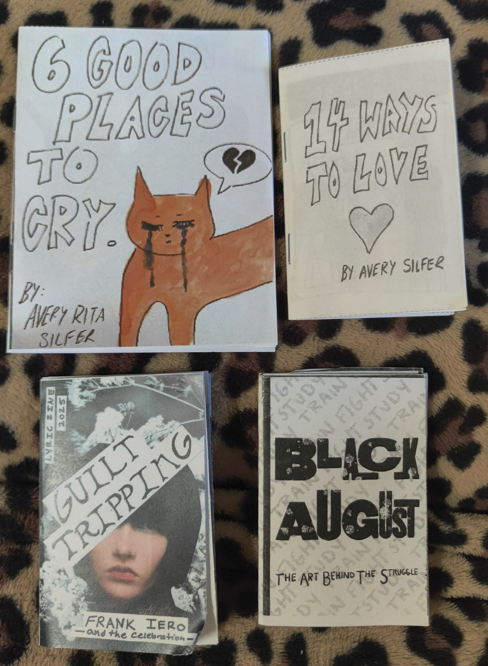
My main goal of the day was to find poetry or pop-culture zines, similar to my own projects. I didn’t see any pop-culture zines but I did find  a few poetry zines, including these three. The far-left one is from a group of artists who have monthly art meetings in their driveway. They then compile a  yearly zine compilations of photos, art and writing that they’ve shared with each other. I told the zinster that felt like a very COVID-era project but they said it was started later. The middle zine has writing from the Santa Fe prison and the far right one is from a poet who creates their own zines.

Another table had compilations of poetry and other art from prison-projects, too. These were $10 a piece and I asked her what her favorite one was and she found it hard to choose but finally said this one. She saw me combing through my purse for cash and said she’d take $5 but I inissted on scrounging together the full price. Nobody’s gettin’ rich on these zines.

Another woman did zines based on research she had done around New Mexican food. (!!) What’s better than a zine? A local zine. I would have bought all the zines she had, but restrained myself to these three:

One table was managed by a professor at UNM showcasing works from student projects. She also showed me this book of hers exploring alternative designs of a book, a “french door” inspired piece called “The Split” which is two sides of an argument that “comes together at the end.” Awesome!


My favorite zines were the ones that had this kind of “thinking outside the box” creativity. Two people had folded zines into those fortune tellers we made as tween girls with numbers and boys names written inside. (Image one and two contain the same zine about extinct birds.) And another used a gumball machine to distribute very tiny zines. That was my favorite. So creative and fun!

I also loved zines that used cut outs. And these were the zines I paid the most for. The pages of this purple zine had hand-painted watercolors,  cut-outs and that telephone pole page actually has string sewn in!

The New Mexico Birds was also a local topic, delicately made and hand drawn. And charmingly tiny!

One final interesting thing was how many of the zines in my haul (some of which I’ll be giving away) had music playlists included in the back of them. Two examples:

Frijoles and Folklore zine also had a whole tamale-making playlist with a great introduction. If you’ve ever made tamales from scratch, you know what an all-day, labor-intensive family event it is. One would need a substantially long playlist for it. Well, Aunt Toodles had one! This shows just how much music and cooking, (I myself love to listen to music when I cook), and music and zine-making go hand in hand. The author had two QR codes at the end leading to Spotify mixes but they are private and unsearchable from Spotify. You have to have the zine to access them. So perfect.

But there’s also something zinely analog about just having the paper list and searching for the songs one-by-one yourself.

I can’t wait until next year.

Revenge Art

Many writers engage in revenge works, usually tell-alls about enemies, colleagues or lovers. the most famous example probably being Philip Roth’s I Married a Communist after his wife, actress Claire Bloom’s own revenge memoir, Leaving a Doll’s House. Poet Robert Lowell was also not above using dirty laundry for selfish reasons. And pop culture is overloaded with “he said/she said” books. (I’m reading two now.)

Short of physical violence, revenge art could be the worst format for revenge (or the best, depending upon your point of view) in that it has some staying power. It doesn’t dissipate as easily as other more transient kinds of retribution that you might prefer soon evaporate after your regrets start to kick in.

I’ve actually been waiting a long time to write about revenge, having had it perpetrated upon me once or twice over the years (and probably far back into my past lives). I’ve been waiting for the Into to Anthro podcast to get to their Revenge episode because it’s a very interesting one, delving into the psychology of wanting and enacting revenge on someone you feel has hurt you. Turns out just thinking about revenge activates the same parts of our brain as gambling does, and like gambling the anticipation is thrilling, but the execution or “winnings’ are inevitably an emotional let down.

I’ve thought about revenge a bit over the last few years and the idea that it’s best served cold. Ever since my mother sent me a box of childhood things. In fact, that very box illuminated the best revenge ever enacted upon me, one served so freezer-burned it felt more funny than upsetting. But I’ll get to that story in a minute.

I want to first continue by saying I’m not talking about the idea of justice, the nice word society gives to its revenge, the social deterrent we use to keep criminal behavior at bay. I’m talking about interpersonal revenge. Anything from the neighborly feuds of the Hatfields & the McCoys to revenge in-coming from a once-intimate partner or friend.  The tragedy about this kind of revenge, unlike society’s revenge which at least does lip-service to forensics, is that it is often, more than not, founded on mistakes and misunderstandings.

This is why, (if I’ve said it once I’ve said it a hundred times), we are our own worst enemy. Because we have serious blind spots and we strike out too often and too soon. Usually this is because when we’re in pain our brains shut down. Anne Power describes this very well in her Ted Talk, how we snap into flight or fight during times of suffering. All behavior makes sense in context, she says, but we’re never in any position to investigate the context when we feel we’re under attack.

Probably hundreds of tales have been told about the many misunderstandings that stimulate acts of revenge. My first exposure to this kind of tragic revenge was when my friend LeAnne, who sat next to me in French class, invited me to start seeing foreign films with her at the Tivoli Theater, an art house in St. Louis. We were probably still in high school or just out of high school when we went to my first foreign film, the French movie Jean de Florette (1986) and its sequel, Manon of the Spring (also 1986). It was a beautiful (and painful) illustration of tragic revenge that I never forgot.

Because the effects of tragic revenge can be devastating in their mistakenness, the risks of being wrong are pretty high. And again, few of us have access to the context Anne Powers describes. If someone attacks you who doesn’t even know you, how can you uncover that context?

So revenge is very human, mostly only human actually. But that doesn’t make it any less dreadful that we are so quickly willing to weld the sword into our own blind spots.

So back to my example of brilliant revenge. When I was a child, I was a bit of a lamenter. I once literally started a picket line in the living room of my grandparents house in Oregon over having to eat fish every night for dinner.

Well, one day when I was seven, my parents told me we would be moving from “Albaqeqe” to a place called Creve Coeur, which sounded very French and exotic to me when I was seven. My parents said it would be a very green place and, enticed by this, I was an early enthusiast of the project. Soon, however, I realized what leaving “Albaqeqe,” (like Pontrhydyfen, it’s an impossible city to spell), would mean for me socially.

Here is an early expression of that emotional trajectory.
Click to enlarge.

(I had such big ambitions for my literary output. But I was misspelling my own name so…I hope I wasn’t too optimistic about winning a Pulitzer Prize. By the way, Candy died under my parent’s bed in Albuquerque a year or so before we moved and my parents couldn’t bring themselves to tell me or my two older brothers for three weeks during which time my parents stalled us by saying Candy was at the vet. She was actually immediately and quietly buried by my parents in our backyard on Claudine Street without any ceremony. But she lives in immortality as my very amazing porn name ((first dog, first street)) of Candy Claudine. So there’s that.)

I also want to say I am not living in “Albaqeqe” again due to some lifelong effort to get back here. Girl Scouts honor. By the time I got to Junior High I forgot all about ever returning and it was Monsieur Bang Bang who wanted to move here to study archaeology back in 2010 and who then become ensnared in “The Land of Entrapment” (as we say).

Anyway…on to St. Louis where I was  placed in remedial classes immediately because I was behind in reading and math was a foreign language. I was allowed to leave science class twice a week to visit the Fern Ridge reading specialist who implored my father to stop reading to me (I was eight years old by this time) so that I would start reading on my own, after which, very similarly to Candy-gate, my parents couldn’t come right out and tell me this but instead told me they would rather watch PBS’ miniseries I Claudius instead of finishing the book Heidi with me, thereby generating in my tender heart a lifelong hatred of I Claudius.

But rather than enact revenge on my parents for all those things, I started reading instead. Like pretty voraciously. In grade school we received a catalog called the Scholastic Book Club. That reading specialist advised my parents to let me read as much as I wanted and so I started collecting books about dogs, haunted houses and a magazine called Dynamite. There was also a magazine called Bananas but that was for older kids. I purchased so many books from that catalog, I always received the free poster and so my bedroom walls in St. Louis were at first covered by posters of puppies and kittens (until those were replaced by Cher albums and posters of shirtless boys). One season I bought so many books I struggled to get the stack home on the school bus.

And I was happy in reading but still pretty upset about being in St. Louis and so I decided to write a letter to the advice column “Good Vibrations” in Dynamite magazine, a column run by Ms. Kernberg. (In my memory, she was a man; but her real name is Pamela Kernberg.) I wrote out my complaints against my parents in that letter, folded it up, added a 15-cent stamp and then gave it to my mother to post.

In hindsight, maybe this is where my own revenge plot went awry.

I awaited Kernbergs response for a year and it never showed up in Dynamite Magazine. I was very depressed about this. It triggered my feelings of invisibility. You could say I never got over having that letter passed-over, literally being rejected by Ms. Kernberg.

Fast forward 40 years and my mother is downsizing in Brunswick, Ohio. She has sent me and my brothers a box of our childhood papers, things she had been saving all these years like badly-formed clay pots, report cards, crayon drawings, all the things. The box took me six months to go through due to being so uncomfortable acknowledging my little wiseacre self. (Worse than invisible, I was annoying.)

But the box was also a gift because inside it, (and through a struggle over my very idea of myself), I found comedy gold, an ability to see that little shit as an idiot, but also very, very funny. Which was gone a long way toward healing from all those childhood slights, from both others and also from myself. (I find if you can’t practice forgiving yourself, you are probably not very good at forgiving anybody else.)

But here’s the thing. Tucked inside all that childhood paraphernalia was that damn letter to Ms. Kernberg! Unsent and opened!! Not only had my mother not sent the letter, she ripped it open, read it and kept it for me to find 40 years later. Okay, probably unintentionally. Maybe she kept it because she thought it was ridiculous. This was maybe unintentional revenge. But knowing my mother…it was perfectly cold revenge.

Soon after finding it, I called her to congratulate her and we laughed about it. She had no memory at all of the letter. Maybe this is because there’s been so much other drama ever since.

I was not upset by my mother’s revenge. Only impressed at the time span of its execution. And my great hubris in thinking my mother would be a secretary to my anti-parent missives to strangers. Besides, I’ve had other revenge that has hurt me far worse. Was it just? I never thought so, but I just can’t seem to drum up the energy or enthusiasm to retaliate.

But beyond my energy deficits, since young adulthood (maybe even since childhood) I have been practicing compartmentalizing my feelings, separating them from my perceived antagonists so as to, yes, protect myself with boundaries but also to keep my feelings honored and valued, separated from the drama of the other person, all in order to allow my feelings to keep-on-keepin’-on…because they are a gift. Your feelings are a gift. Some people never get them. In their whole lives. And they’re desperate for them. So if you can separate your feelings for someone apart from what you think they may have done to hurt you, then you won’t lose everything.

I don’t do it perfectly, of course, which is why it takes practice. Like everyone else, first I have to calm down.

Which brings us back to art and writing, which is a great space to practice this compartmentalizing. Practicing art, I would argue, is better than revenge, better for your own soul. And probably more fruitful and healing besides, that which gives and receives, instead of more and more and more suffering, the mastery of grace.


Going through the covers of Dynamite Magazine this week, I discovered some interesting things:


Pop Song Poetry

I got back from a road trip to Cleveland this month which is a three-day drive I quite enjoy and have done a few times now. In the car, I spend much of the time scanning through various Sirius music channels and occasionally Spotify’s radio channels based on artist algorithms. Usually I come home with a list of new music to explore from Sirius stations like The Spectrum:

https://youtu.be/wJO0IoWY4t4?si=VfFHx-iSFO7Xpk6f

https://youtu.be/zccVGbRbjII?si=pyKfLD4m8SlUPXOP

https://youtu.be/5cXCUp6j5M8?si=PoLY7_WGGmTvOrjK

Or (not-so) guilty pleasures I haven’t heard in years (I totally forgot about these guys!): https://youtu.be/sGsWJ0PcLfU?si=n-I8-fZOAT8xH7Lh

But this trip’s music plays served up a song or two that I hadn’t heard in years if not decades and their lyrics reminded me they had been substantial life guides to me from back to childhood or young adulthood.

I can’t think of a single equivalent poem that has done this for me, a verse with a line that pretty much guided my entire life. For example, since poet Andrea Gibson died recently of Ovarian Cancer, she’s been on everyone’s mind (for some, like me, for the first time). My friend gave me her 2015 book Pansy and as I read it I haven’t found a poem I didn’t love. I’ve underlined most of the book’s amazing metaphors and lines. The book will definitely guide me in activism and on sorrowful days, but poetry tends to be complicated and to complicate. It tends to beautify the complications, not to simplify them.

And as I get to the end of my life, I can appreciate how solid some of the pithy pop song advice actually was.

The first song along this line was “Peace of Mind” by Boston, a band my two older brothers both listened to. I remember driving around St. Louis before I even started working full-time jobs, coming across the song on KSHE while flipping through the dial and thinking these lyrics sounded like very sage advice written by the band’s Tom Scholz.

“I understand about indecision
But I don’t care if I get behind.”

Back in the late 1980s and early 1990s we didn’t have lyric websites (or even websites) and so my version of the lyric was “I don’t care about gettin’ real high” (corporate-ladderly speaking). Same idea.

“Now you’re climbing to the top of the company ladder
Hope it doesn’t take too long
Can’t you see there’ll come a day when it won’t matter?
Come a day when you’ll be gone.

…People living in competition.
All I want is to have my peace of mind.”

The amazing thing is, I have never questioned this idea and have followed this advice at every decision point of my office and writing life. I lived this and have no regrets. I didn’t climb the corporate ladder. Maybe I would have been more envied or more laid if I had, but I had me some great peace of mind.

“Lot’s of people have to make believe they’re livin’
cant decide who they should be.”

I’ve seen this everywhere, year after year, in friends, family, co-workers, on TV and social media, people presenting a life that is enviable I guess, but pretty worthless tbh. I’ve had a lifetime to see it play out.

And how increasingly emphatic was  Scholz’s final suggestion?

“Take a look ahead.
Take a look ahead.
Look ahead!”

I heard the same idea expressed in the positive this week by Jim Croce’s “I Got a Name” with its declarative “I’ve got a song. I’ve got a song… If it gets me nowhere, I’ll go there proud.”

There are no poems I’ve read that can compete with this good counsel so compacted. And not even any line from a movie I can think of. Although I did write a poem a few years ago that mentioned how lines spoken by Jessica Lange to Dustin Hoffman in Tootsie have always guided my decorating decisions, specifically as regards to wallpaper, but that’s another story.

Dustin Hoffman brings us to the fact that I saw Rick Springfield in concert a few weeks ago with two younger gal pals and I pitched to them about my theory that Rick Springfield once caused a lot of early-80s tween girls to go suddenly boy crazy. I asked them who it was in the later-80s tweens who might have turned them boy crazy (even though I already knew the answer). They confirmed it was Simon Le Bon of Duran Duran. A large swath of girls my age and younger did go nuts for the boys in Duran Duran. But I had no such rock singer for myself because all my crushes were on actors, with one exception later. Maybe I took this Peter Allen song too much to heart at age 8.  Musicians seemed like bad news. Although, as annoyed as I was with Rick Springfield, I would have picked him before Simon Le Bon. Turns out actors weren’t such great news either. And comedians could be the worst because they’re always on and everything in their lives is fodder. (It’s the devil you know.)

Anyway, the actor who convinced me that boys were worth the trouble was Paul Sand (and not Barry Manilow as one could imagine; I had a sixth sense about that one). And interestingly, I eventually discovered this thing I loved about Paul Sand was not transferrable to other boys who looked somewhat like Paul Sand. This was necessary because Paul Sand was very, very obscure and I didn’t have a video recording device back then to catch him on The Mary Tyler Moore Show or The Carol Burnett Show. He was hard to come by. I tried to like Dustin Hoffman (meh) and Jeff Goldblum, who is very interesting person but he didn’t take, although I came across this very funny thing today:

…and later Al Pacino (which did take for a minute because he had the best movies, but my enthusiasm for him also did not last).

There was just some essence of Paul Sand that went beyond the markers of his physical self. And it operated on a level of intuition I could not rationalize. Maybe it was contingent upon past lives or maybe it was simply a heart’s broken mold.

But anyway I was driving to Cleveland after the 80s Rick Springfield show and his self-penned song  “Don’t Talk To Strangers” came up, another song that seemed like a monster-hit during that time I was losing all my friends to Springfield’s pop enchantments. It was for this reason I had avoided the song and its lyrics at the time. But this line came through to me now:

 “Who’s this Don Juan I’ve been hearing of?
Love hurts when only one’s in love.”

The simplicity of that caused some laughter in the car. But it soon occurred to me that hundreds of thousands of pop songs have been written all-to-say. It’s actually the ultimate statement of the situation. I mean…all other explications are always appreciated forever in perpetuity, but this is the tightest summary for sure.

To love someone all-of-itself should be enough. As one of the great show-tune lyrics of all time states, “to love another person is to see the face of God.”

But that is never enough somehow. Like 500 miles away from enough.

Which brings me to the another song that has guided my life through many decades, although unlike the Boston song, I’ve always struggled to follow it.

As someone from a gambling family, (I convinced a friend in St. Louis to play credit-card-roulette a few weeks ago), I’ve always appreciated the extended metaphor that is “The Gambler” by Kenny Rogers. Whenever a teacher asked a class I was in to assemble a list of our favorite poems, I always included this lyric by Don Schlitz in my list. The song is a fully-realized extended metaphor about how to live life, the tenor, through the vehicle of playing out a hand in poker.

“You gotta know when to hold ‘em,
Know when to fold ‘em.”

This is a good time to say I am a family-famous terrible poker player. The game always demanded quicker decisions from me than I was ever capable of making and I never could make sense of all the possible patterns in front of me. (You can work out the life-metaphor there yourself.) Years ago I was playing with my family in their tradition of playing among variations of the game. We were in my oldest brother’s kitchen (in Boston coincidentally). I was always coerced into playing and for me it was always a few hours of feeling both performance anxiety and boredom alternatively. I was allowed a cheat sheet that made no sense to me (I was in my mid-20s, too.) My brother declared himself the winner of a hand and started pulling the chips into his stack. Then it was my mother who said across the table, “No actually, Mary has a Straight Flush.” I couldn’t see it. My brother had already confused the pots. And he was pissed off! He angrily said, “Mary shouldn’t play if she doesn’t know what’s in her own hand.”

(Lord have mercy, metaphor. Lord have mercy.)

And that was it, the last time I have ever played a game of poker or ever will. It was like a (somewhat traumatic) get-out-of-ever-playing-poker-again card.

And now, looking back over my life since I first heard these words of “The Gambler” sung so deadpan by Kenny Rogers, I see so much does seem to depend not upon a red wheelbarrow but upon knowing when to fold ‘em. You could spend decades of your life holding on to what turns out to be, if not technically a bad hand, (after all, every hand’s potentially a winner and a loser), but one of those hands that you will never be able to win with.

Knowing when to hold ‘em and when to fold ‘em is where all of life’s most heartbreaking lessons in love and in work seem to be, especially for those of us who have never been able to tell the difference.

Poems in Pop Culture: Murder Mystery Games, Movies and Sculpture

Holiday weekend was a staycation birthday celebration for my friend Melo. We were all going to go away to cabins up north, but due to all the instabilities in the country, we switched our plans to a weekend of local things, including a group walk on the Bosque, game night, bowling, breakfast out and a trip to an Albuquerque art museum. We had downtime in the evenings which for me entailed a night of watching 1970s YouTube videos of the Dutch show TopPop and the next night watching the movie Deadstream.

Interestingly, in almost everything we did, poetry popped up.

Game night

I have a few Deadbolt Mystery Society games, (a company which seems to be drastically downsizing now, sadly), which some of my friends like and so the six of us spent an afternoon playing “The Cleansing of Killian House.” These murder mystery games are group efforts to solve mysteries with puzzles. Some puzzles lead you right into the final answer, puzzle by puzzle, and some force you to use logic to eliminate innocent suspects until the final one is revealed.

I’m actually terrible at puzzles (and board games), but I love the doo-dads of the game, the way the story is assembled with little narrative scraps; and I can organize and facilitate the process for others who are have better minds for puzzles. Rarely am I helpful. I did solve the puzzle depicted in the picture above (which is why I took a picture of it, being a momentous occasion and all).

This game’s theme was ghost hunting and the “guest host” of the game was Nick Geoff from Ghost Adventures among other TV shows. I once really enjoyed the show Ghost Hunters but then decided all these shows, despite the evolution of their ghost-detecting technology, never did really unearth much.

For example, the green cards above depict a technology that was much ballyhooed when it came out, the SLS camera, which could apparently capture ghost folk in stick figure form. This was actually made ridiculous on one show that was  investigating a western ghost-town dance hall and the SLS camera allegedly captured a stick figure who appeared to be doing a boot slapping dance. I found that pretty funny. Anyway, after a false start with this puzzle I figured out that the stick ghosts were actually pointing to directions of push-able bricks in a secret door of a brick wall. It’s complicated but the point is we got there.

During the game we had to explore six rooms of a mansion (six envelopes with cards, paper and toy objects in them) and one room was the Library which made us solve a book-spine word puzzle and the story introduced us to the Library’s hired book collector who collected antique books and was invited to the house to validate an original copy of Edgar Allan Poe’s Tamerlane and Other Poems but then he got murdered.

Movie Night

On Saturday night after an afternoon of bowling, Monsieur Big Bang said he wanted to watch a comedy horror. This was surprising. When I met him back in 2005 we had to sort out one very important issue: he hated the horror genre and I loved it. Fast forward to today and he (and his family) are doing the ghost hunting, watching all the ghost-hunting shows and M.B.B. spent one season obsessing over Italian Giallo films.

But back then he loved to pick apart the horror movies I made him go see. And there are things to pick apart in those movies to be sure. But the latest generations of horror filmmakers are doing some great things, including people M.B.B. knows like Jason Blum and people M.B.B. admires, like Jordan Peele (Get Out was a property of both). But there are other smaller auteurs who are making low-budget horror films for the streaming channel Shudder, which I don’t even watch and I’m not even really into anymore.  (I haven’t even seen the Chaz Bono TV shows and movies yet.)

I just happen onto some of these good things in passing. I tend to like to see how a moviemaker can stretch the genre (which is what I like in westerns, too). A genre is like a poetry form, a sonnet or a villanelle. It has rules and structure. How can the form work to tell a story about racism or the sexes or culture itself? How does horror comment on our collective fears?

If you’re looking for just funny scares, Shawn of the Dead is probably the best. And I don’t feel the Scream movies hold up but Scary Move 2 does. (I’ve seen it many, many times just for Chris Elliot and David Cross.) Get Out is a great example of a modern story about subversive racism, as was the classic Night of the Living Dead before it.

Josh Ruben’s Scare Me was billed as comedy-horror and it was humorous but it’s wallop was very serious and two-fold, (1) being an engaging horror movie with a limited set and mostly based on dialogue, and (2) having an unlikeable female lead character that challenges everyone’s (including women’s) internalized sexism. The lead male was a fragile and bitter failed writer and I heard myself shouting at the screen at one point, “Oh no! Don’t offend his ego! He’ll kill you!” And then “Did I just say that?” That the filmmaker was a male writer and director asking his (male and female) audience to rethink whether a female character (or a real-life woman) is required to be inherently sympathetic and nurturing just because she’s a woman…well, that’s pretty amazing. It shows the problem in story form. And your response to it tells you more about you than could be found in a typical horror film.

Deadstream was written, produced, directed and edited by married people: Vanessa and Joseph Winter. The husband is also the lead and the soundtrack composer (used to comedic effect) and this movie is laugh-out-loud funny.  But it also happens to be a commentary on influencer culture, the dare-devil male monster (Shawn) and the affronted-female monster, which in this case was a “social outcast” poet from the 1800s named Mildred Platt. The poet’s father built her the now-haunted house our influencer/dare devil protagonist is spending the night in to win back followers after a disgraceful downfall involving a racist incident. The poet’s tragic life as a failed poet and nearly-wife of a handsome publisher leads to her suicide and our influencer will now try to antagonize her.

To make the monster a poet was brilliant and probably not new. We’d have to watch all the old horror movies and I’m sure we’d dig up some dead poets who were upset about something. Poets are seen as somewhat “off” even in real time. I mean living poets are so obscure and rarely-read, they are quintessential anti-influencers.

Our protagonist, Shawn, is very unlikeable (and yet kind of likeable in a strange way), and he pisses off the poet-ghost who then tries to kill him. Meta comments running down his livestream occasionally are very funny easter eggs (but you have to pause the movie to see them), not to mention easter eggs in the writings on the walls of the fabulous set.

Soon Shawn finds a secret door which leads to a chest which has a secret compartment which has stashed in it Platt’s handwritten book of poems.  Shawn is very disrespectful and dismissive (as he naturally would be) and he reads a bit of the book:

“Maybe this is the secret of the house,” he says (which is what any other hidden book in a haunted house movie would mean).

“The dianthus are blooming.
The birds are cooing.
Your visage is in the sunlit canopies.”

“Never mind,” Shawn interjects, “These are just poems. They don’t even rhyme!”

The poet responds (eventually) with the fury of the artist scorned. Shawn soon discovers that as the poet kills people who have lived in the house, they also become ghosts in the house and he meets them as the night progresses. During the climax of the movie, Shawn has an epiphany. He’s hiding in his car and he sees something he understands in Platt’s handwritten book, a phrase about pond water that had been repeated in the notes of a previous ghost-hunter.

“She’s forcing them to read her poetry!” Shawn exclaims. “What a freaking weirdo!” Shawn understands Platt suddenly.  “She’s like me. She wants an audience. She kept trying to get me to read her poems. She’s building a following.”

Shawn goes back in the house and confronts the poet with, “I understand why you do what you do?” And he commiserates that they both, each in their own way, tend to go too far from time to time. To lure her out of hiding, Shawn reads her poems aloud as he walks through the hallways with a spear-cam (the cam jokes alone…):

“Echo my heart.
Echo my soul.
Bring my voice….”

(and he is interrupted by a noise in the house.)
“Black birds roam.
Their voices moan.”

“I mean, some of these are pretty good,” Shawn says and then whispers to the camera, “Not.”

(He deserves to die, this one.)

I had to have the ending explained to me but I was very impressed once I understood it. Many horror movies of late have ended on defeat for the protagonist. Deadstream’s ending even challenges our ideas of that in a very satisfying way that is also a commentary on having a following of any kind. The movie is a commentary about fandom, thirst and fame at all costs and a spoof of the most recent ghost hunting tv-show genre. And like the best of comedic horror, it’s very funny but also pretty scary. A very smart script.

Trip to the Art Museum

We all went to the Albuquerque Museum on free first-Sunday to see a show called “Light, Space, and the Shape of Time” which was a collection of pieces that use light as a material. One in our group happened to be the granddaughter of artist Florence Pierce of the Transcendentalist Painting Group and one of Pierce’s later pieces was in the show.

My friend Mikaela also does a good deal of family work tracking all the shows her grandmother is in so I was able to ask her about the lighting of the show and how difficult it is to light Pierce’s pieces in other shows.

There was also a sign-sculpture at the front of the exhibit that used sentences about the body. You could only read them at a certain angle due to the light.

The artist was Jenny Holzer and she often works with words.

https://www.hauserwirth.com/artists/2857-jenny-holzer/

https://unrtd.co/media/tate-modern-jenny-holzer-exhibition-artists-rooms

More on this museum show:

https://www.abqjournal.com/lifestyle/article_6a9a2066-0b64-42fb-aaae-50ab4563d6f2.html

While we were all in the bookstore (where I bought a Florence Pierce book), Mikaela went through the “Abstracting Nature” exhibit that included 10 New Mexico artists doing pieces about the New Mexico landscape (I’d like to go back to see that). She found more poetry-based content there and texted me the following pics from an exhibit based partially on Shel Silverstein’s “Where the Sidewalk Ends” poem.

What Is Poetry: To Reveal the Self or Disclose the World?

This is our last blog post covering questions about what poetry may be. We ran out of Elisa New questions (from the Harvard Emily Dickinson MOOC) in the last post. This question is a bonus question I cobbled together somewhere between reading about Gary Snyder and Jack Spicer last year, a question poised somewhere between the Confessional/Beat poets (who make appeals from the self) and the LANGUAGE poets (who try to reveal a reality which does not include ego-driven ideas of the self).

I find this a very interesting, advanced question: what is the purpose of poetry, to reveal the personality or to disclose the world as authentically as we can (in all its scary nebulousness), to explore our many personas or to abandon the idea of individuality altogether?

Poetry camps each feel very strongly about this. And, as you can predict, I hate to take sides in these poetry matters. Again, how can you choose? Like all these attempts to define what poetry is and what poetry does, there are easy cases to be made outside of any staid definition.

If we’re honest, most humans can’t really function outside of a sense of self, despite the precariousness of the self in any biological sense. Psychologists can show how and why we construct our ideas of ourselves so we can mentally move through the world. And we need the idea of other selves to help us come to terms with the mysteries of human behavior in others.

But some (very Zen) humans can also operate with a more fluid sense of self, of being part of a collective self (without feeling threatened by losing the assurance of an ego). Other people need a strong sense of self, a bolster that helps them understand where they begin and end in the world. And then some people just want to think of themselves as the center of the universe.

So this determines the kind of poetry each type of person needs to write.

It’s probably a healthy practice to try both kinds of consciousnesses and write poems that explore each point of view (or pointlessness of view).

After all, without personalities to communicate from and to why bother? On the other hand, with an intransigent sense of self, you are going to get stuck in the pointlessness of that as well. Without being willing to a kind of fluidity and openness to changing your mind, why try to communicate with others? Because if your goal is just to force your perspective on everybody else, you are doomed to fail and feel alienated as a result.

What Is Poetry? One Moment or an Eternity

We are to the last of our Elisa New questions from the Emily Dickinson MOOC. We have one more bonus question later but this is the last in New’s string of musings to her students about what poetry is or how we can define it.

This last question is long: “does a poem live more fully in one distinct moment of performance, like a theatrical performance, like a dance performance? Or does a poem live across time, such that any one performance is inadequate to what the poem actually is?”

Unlike how poems were originally transferred from person to person before the printing press was invented, and unlike how music, theatrical and dance performances operate as one-of-a-kind, communal experiences, poetry can also be transmitted by the technology of books, its own machine of mediation.

So “performance” takes a different meaning if you consider the “performance” on the page. How does a poem perform across and down the white space of paper and across pages? A private reading is also a kind of performance in your own head, in your own imagination. You are the eternal performer in all your readings.

Live events are communal events. Who hasn’t felt the energy of being part of an enthusiastic audience? Any piece of work that has been preserved and then experienced in another time and place through a mediated device is a different experience. Just as experiencing the plays of Shakespeare are unique to their time as opposed to their very first performances. The cultural context has changed. Time changes culture which changes the context of reading any art.

The media also affects the experience, changes in books, new technologies. Watching a video on MTV in the 1980s is a different experience than watching it on YouTube. Hearing AI read a poem aloud is quite different than hearing a monk read it centuries ago. A paperback book is different than a computer printout which is different than a book that was handwritten. These are both intellectual and emotional differences. They land differently in our heads and hearts.

Are all these pieces of art different if differently experienced? They may use the same words from context to context and medium to medium. Does even the reader change what is read? I recently read a allegory for fandom that described two people riding a roller coaster. Their bodies experience the same ride in the same objective way but one loves the ride and one hates it. Their interpretations are based on their personalities and expectations of pleasure.

So one set of words could have infinite performances across time and media, and infinite performances even in one moment across the array of an audience.

What Is Poetry: Is a Poem a Container?

We have three more of these to do, three more Elisa New questions from her Emily Dickinson MOOC many years ago. This time we have two related questions she asked: Is a poem a container that holds a set of meanings or is it an expansion or dissemination that defies all containment?

I feel like this must be the easiest question she’s ever asked us. Because nothing is a container. Not even a Tupperware container. And yet…poems can be usefully seen as tight little containers (compared to novels, for example).

Maybe formalists build poems to be containersBut nothing we really do or say can be hermetically sealed. Even, I would argue, if we never ever share that poem with a single other person. It disseminates and expands into us as creators.

Like man, no poem is an island. And yet it is truly maddening for some people to think about how porous the borders of all things are, even their own skin.

Often people rely on black and white thinking, probably the most popular coping mechanism devised by the human mind for all of time. But like trying to seal the unsealable, black and white thinking is very unreliable, if not just plain self-sabatoging.

Things are not either yes or no. They are always yes and no.

I learned this at a very young age. It’s a story that has to do with a family member with depression and it’s not a story I can tell in a forum like this but suffice it to say the experience taught me a foundational lesson in what we call a paradox: two seemingly contradictory facts often can be, nonetheless, true at the same time.

And not only did I learn this lesson at a very young age, I also found out that once you see a paradox in one place, you can’t help but see them everywhere. It’s all or nothing. Which is why my thinking often hops from a definitive statement to “well, but except for this….”

This is the kind of thing that sends men out babbling into the street. It’s mentally hard to reconcile with. It’s emotionally hard to reconcile with. Enter black and white thinking. As I see it, people have three choices in this world when dealing with life’s plethora of paradoxes: (1) go nuts, (2) retreat into black and white thinking or (3) do what Georgia O’Keeffe calls “walking on the edge of a knife.” It’s the hardest of the three things for sure.

Speaking for myself I can’t use black and white thinking. It would be a constant argument with reality for me and I don’t have that kind of energy. I also prefer not to go crazy, so that leaves the knife.

And speaking of Georgia O’Keeffe, Gene Hackman who recently passed in Santa Fe, was one of O’Keeffe’s Santa Fe museum’s celebrity supporters, serving on the museum board from 1997 to 2004 and narrating the museum’s video that was played multiple times a day for many, many, many years there. I’ve taken quite a few people to that museum and watched that welcome video so many times.  It explains northern New Mexico, my family’s terra sancta, like no  other I’ve ever seen. It’s in this video that O’Keeffe talks about walking that knife. And that’s why I’ve always remembered it.

It applies to more than painting and writing. Nothing is simple. Nothing is simply its own self. Nothing is only one way or another. And that is both immensely frustrating and incredible beautiful, as any paradox is.

R.I.P. the great Gene Hackman (and also the great Georgia O’Keeffe).

Turn and Face the Strange Changes

Well, the world is feeling like a Goya painting right about now. And it’s been a while since I posted. The dregs of 2023 turned into the insanity of 2024 which became the horrors of 2025.

But I’ve been meaning to talk about a stack of books I have on my office floor. Some books I recommend and a book I just can’t break into after many years and many attempts.

My big problem is that I’ve hit up against more pressure that extends my crisis of mission with this blog.

First of all, what does it mean to be a creator in the new world of AI where if you create a poem without AI, could you prove it?

And how can you be a public writer (an Internet writer) in a world where AI scrapes what you create in order to take creativity out of the hands of the creators? My little corner of the universe, rarely visited, has always seemed a perfectly safe corner, secured from a largely disinterested populace. But from scarper bots, not so much. From a government that has ceased to believe in human rights and privacy, very much not so.

Last year ended badly, with the convergence of advice from other writers to protect my online writing. (Actually that advice came during a writer’s retreat in Winslow last spring, which then set to nagging at me). Then there was the scary research being done by Intro to Anthro with 2 Humans about AI (which I could feel myself wanting to avoid in conversation but from which I was unable to stop listening or support the poor soul who was reading the worst of it).

Then there was a novel I chose to read in December about the abuse of social media to kidnap people (which freaked me out enough to made me want to go off the grid immediately), a book which was unfortunately immediately followed by a novel given to me by my bestie for Christmas about smart women who fall for amorous predators (the story did not end well) and other stranger dangers; and add to that a family identity theft, a health scare, government shutdown predictions, threats of job outsourcings and well isn’t that enough?

No. The universe said, I give you 2025: plane crashes, fires, fire-related insurance dystopias, data theft, government coups. Now all my friends are also having a bad year and not just me. Isn’t that swell.

I have to change my life. I have to change how I sell books. I have to change how I distribute my thoughts. I have to accept that my time in that world may have to come to an end. Because I have to remember how I was living before the Internet and social media and free shipping and the world being delivered to my feet.

The fact is the Internet is a very public space, and likely no longer a safe space. There are new articles around instructing us how to make our lives more secure and this has to do with removing our public selves from the Internet and going private. This is, honestly, very challenging for me. I am not a public figure by any means, but I am a public person. I have loved meeting strangers and making connections. I have loved sharing and helping others through words and with my sites and blogs. And I believe, in maybe a very small personal way, I have made a positive contribution. I hear from poets and Cher fans throughout the year and I am moved to help and to be informed how I have helped people in even small, informal ways by an idea or a tone of response.

I’m a helper bee to the core. I had to always make that clear in interviews for admin jobs in Los Angeles, where everyone was looking for gate-keepers. I had a boss at ICANN who literally had to tell me where all the gates where so I could resist helping people. It’s just not my natural disposition. I seek to help. But what does that even mean in a world gone mean?

On the Intro 2 Anthro with Two Humans AI podcast episode Monsieur Big Bang says somewhat significantly that as a person committed to lifelong learning and creating, “I can feel myself disappearing.”

I feel the same way.

The only difference is that I see a small ray of hope where he does not. I think this dystopian situation will push us toward more local and in-person lives again. Speaking for myself, I have taken some small steps to regain stable ground as a person in this world, I have made changes to the stores I shop at, the browser I use, the email service I use.  (And doesn’t it seem when you move from email address to email address in this life, or from social platform to social platform, part of your life history disappears with it?)  I’ve secured some unsecure things. I now think twice about adopting free services and I now opt to pay for more secure products. I’ve moved a lot of content behind passwords.  I’ve printed down important documents and am in the process of removing my content from many cloud-based services.

I am becoming a physical, meat-space person again.

I am also “unfriending” people who seem to be taking delight in the suffering of others right now.  Because just being around them leaves me feeling that the world has become a grotesque place. Which maybe it has.

In fact, to motivate myself forward, I’ve instituted Outing Day for myself every Friday. It’s a day where I gather a list of things I would have purchased on Amazon or other delivery sites and I get the hell out of my house and go to brick and mortar stores to buy all my shit, sometimes compromising on what I wanted to accept what I can find. It’s beyond the idea of supporting my local, small businesses. In the last few months, I have seen many ways big national and international corporate companies are failing in their bigness. So it’s just as much about protecting myself as it is supporting smaller things.

This is why on most Fridays you will find me visiting Books on the Bosque, probably the smallest new-title bookstore I have ever been to. I’m making friends with the man at the front desk as I give him my weekly list of books I would like to order. The out-of-print-rest I get now from Thrift Books. (Abe’s is now owned by Amazon.) And then I wait for them to arrive, sometimes for a whole week!  Brave new world.

Anyway, aside from all that, here are the books from my office floor I want to talk about today.

The Book I Can’t Read

As part of my cowboy poetry collecting, years ago I bought a very used copy of “The Land” by V. Sackville-West (1927) and every few years I try to read the thing. It’s written in four very long poems (based on the seasons) of very dull impenetrable, tangled blank verse. I am giving up on it yet again, but once in a while I pull it off the shelf and read a random page and somehow that makes more sense.

Recently I did find a cowboy poetry anthology on the shelves of my parents new independent living library in Ohio. I have purchased my own copy and will be attempting that one next.

Black History Month Books

There are a few black writers that I’ve been reading over the last two years in this stack as well. And since it’s Black History Month, an effort currently being attacked, I feel this is a good time to highlight these books. In fact, while I was in the Cleveland area recently I heard a radio DJ there joke that night itself will soon be made illegal because it is so black. He was joking but it’s not really that funny in light of all the books on slavery and civil rights that are being banned from American school libraries as we speak.

Percival Everett is a popular author in my Difficult Book Club (our book list is one of my most popular pages). I recently had a chance to read one of his books of poetry, re:f (gesture) from 2006. I didn’t love it. In fact I mailed it to our group’s Everett superfan over Christmas. It seemed simultaneously thin and unwieldy. But I will definitely keep trying his other poetry and highly recommend his novels (of which I’ve only read three so far but he is one of those authors, like Murakami, Twain, David Foster Wallace, Anne Carson, Albert Goldbarth and Thomas Bernhard that I keep craving every once in a while.)

For my intentionally woke book club (we call it the anti-racist book club), my two St. Louis friends and I read a book of erasure poetry called the ferguson report: an erasure by Nicole Sealy (2023). My two friends are from nearby Ferguson in St. Louis (Black Jack) and they are very heart-invested (as two white catholic school girls who grew up there) in that now mostly-black community. I was from West County, an area between the small suburban cities of Creve Coeur, Maryland Heights and the more affluent Chesterfield. St. Louis (and the state of Missouri) is a pretty racist place so that gives our book club some solidarity. West County tends to be obliviously privileged so that makes me a very proud graduate of the DEI-since the beginning-of-time UMSL college.

The eight poems of the book are lifted from a reprinting of the official Ferguson Report from the riots of 2014. The report itself  has been grayed out and a handful of words and letters pulled through. For this reason the book is not like other erasure poems with a higher concentration of words per page. And because the report is not really readable itself, my two friends took the extra step of downloading the report separately and reading it. I was unable to do that last year because I was tied up with trips to Cleveland and the contemporaneous act of losing my mind. But I should because my friends tell me the report was actually a more meaningfully and impactful read than the poems. But that said, we all liked the resulting eight “lifted” poems which are also reprinted in the back. It was an interesting and worthwhile experiment.

The book I would most highly recommend, Blood Dazzler by Patricia Smith (2008) is about the black experience during Hurricane Katrina in August of 2005 in New Orleans. The narrative thrust of it, the tribute to the city and the meaning Smith can always draw from public and pop culture events all make the book a amazing read. Poems take the voices of many characters, including a dog named Luther B and the hurricane itself.

It’s heartbreaking and monumental and one of America’s best poem sequences.

« Older posts

© 2026 Big Bang Poetry

Theme by Anders NorenUp ↑