Reinventing the Life of a Poet in the Modern World

Category: Poets in Action (Page 1 of 15)

Tech Fails and The Malevolent Provocateur

I was in a team meeting  a few months ago and my boss noticed, apropos of nothing, that my name, Mary McCray, has, (eerily and evenly), two Ms, two As, two Rs, two Ys and two Cs. Like my whole name is a duplication of the letters M, A, R, Y and C.

And then he searched for annograms of my name and the one that best described this strange situation was “Marcy Marcy.” He jokingly found said this was probably messing up the matrix.

I said that sounds bad but just add it to the pile of all other things.

Sigh.

Breaking the Spiritual Matrix

I’ve been sitting on this post for months. Months! It felt too depressing to post. Not that I’m above (or below) posting gloomy. When the time calls for. Because I like a good grouse as much as anyone. But this one felt really complain-y.  And how useful was that?

It’s basically about all the tech fails happening all around us (and what this means for creative people). And I’m not just talking about new tech problems, like A.I. or the  occasional A.I. “hallucinations” although those are kind of batty when they happen. Asking A.I. to explain who Mary McCray is has been both fascinating and disturbing. For one thing, A.I. thinks more highly of me than I think is true. I had a book club meeting and we’re all writers so we talked about that and I’m convinced A.I. is trying to ingratiate itself by blowing smoke up our asses. And then just the wrongness. For example, A.I. had me co-writing a very famous song. And aside from helping my brother get out of a lyrical dead-end once every few years, I’ve never written a song in my life.

But I’m not talking about all that. I’m talking about tech things that have been working forever and suddenly they are not working…and nobody knows why or how to fix them anymore because systems and technology have become too complicated to unravel and fix. So the problems are left just languishing out there in the open like abandoned motels on the side of the road.

Wholesale things on websites, like links and redirects not working. Email confirmations not working. Phone apps not working. Virus scanners getting confused. Phone trees breaking down. My text app can’t handle group threads anymore. And it’s been broken for over a year. Business processes breaking the minds of the people and machines tasked with following them. It’s like we’re arriving at a tipping point where technology is doing more harm than good and people are dumping their “smart” appliances for “dumb” ones….just to be able to, for example, do their laundry.

The amount of phone apps we are required to have just to make hair and doctor’s appointments, get grocery store coupons. Not only are we having storage problems, but the elderly can’t fill out copious amounts of pre-visit online forms when they can’t understand the ten steps needed to access them.

A recent airline ticket QR code stopped working for me 30 minutes before a flight and the flight attendant has to print a ticket off for me. Like on that amazing technology of paper.

A doctor I’ve been trying to see finally cancelled my appointment this month because they can’t navigate my insurance situation. They tried for six months and finally we both gave up.

What a mess everything is.

And then there’s this thing they are calling a decline in our attention span. I call it becoming illiterate. Over the years, I’ve watched a very, very smart friend struggle with any kind of longform reading at work. When a long email comes to this person, they struggle with “too much information” and the bullying “wall of text.” It’s like all the microcontent we have consumed over the years has made my friend illiterate.

People are losing their jobs just as paywalls are going up everywhere for formerly free services.

Technology has suddenly become very political.

All of these are major tech fails. And I’m not the only person to notice. Everyone is noticing it.

Good ole Yankee ingenuity, our historical faith in labor-saving devices. Innovation and invention, fads, disruption and planned obsolescence, our obsession with the youth is really an obsession with the new. These are all American themes.

But for the last few decades, technology has been disrupting the wrong things. Why not disrupt health care and the fiasco of health insurance? Why hasn’t anybody taken that on? Imagine the countless amount of suffering that could have alleviated.

But hey, we can shop with our voices now and we don’t have to use our fingers! Next day shipping! Credit card information is saved for all future purchases on any website. We can send our friends money easily now!

Do you see a pattern here?

What is the utility or efficiency of having people forced to be ambidextrous between Mac and PC, Apple and Android? There is none. Why should developers have to design things that need everlasting updates. As we’ve seen with digital art, artists and writers can’t keep maintaining their pieces out from eventual technological obscurity.

You now need a gazillion programs to do your job (even toilets are getting complicated) and none of them sync seamlessly with any other. There’s always a glitch that requires manual intervention and workarounds. I have a whole separate tirade I could make about how work tools have mostly made work tasks more difficult and time consuming for us. We’re doing so much babysitting with the tools, we have less time and brain capacity left over to solve the real people problems our jobs are trying to manage.

TV apps have made TV watching too complicated. To reinstate my AppleTV account takes a phone with a QR code app (that never works), a URL to use on my phone or computer, then a verification number sent to my phone and then a password to get into my website account. So there are many walls I have to scale just to give AppleTV my money. And it’s been that way for years. They’re not trying to fix real problems.

Disruption a big word in technology. It’s a goal for designers and “visionaries” but it’s been a nightmare for real people, especially older people. One of my parents has cognitive issues switching from one streaming TV app to the other (let alone dealing with their four separate remotes) because each one functions differently. As technology continues to make our lives more complicated by the day we’re starting to see that cognitive breakdown creep into younger and younger minds, like my friend above with the reading issues.

If you can’t get your washer and dryer to run because the internet is down, that’s a tech fail. If technology puts people out of work and makes them go hungry, that’s the biggest tech fail there ever was. And the biggest irony is that layoffs are beginning first with the very technology employees who have been designing our human obsolescence.

Benevolent vs Malevolent Provocateurs

I want to talk about the idea of disruption because I hear a lot about it. And not just in technology. It’s a big word for writers and artists, too. It’s just not called “disruption.” But it’s been on most writers agenda since modernism. Shake it up. Helping people is never on the agenda. Not really. Not truthfully. It’s the drive to be known as the person who shook it up.

Figure out a way to disrupt the canon, a way to challenge allegedly complacent people. The most respectable artists have been considered provocateurs. And it’s been so culturally and socially admired, everyone wants to do it now.

And it’s just not scalable, socially or morally.

I was at a party a few months ago and there was a libertarian there who we all like and who is a very smart and funny person. He was talking about trolling his co-workers on Facebook and he said, “I just want to fuck with people.” And I wondered, to what end? To get them to “take themselves less seriously,” he said, very seriously.

I recently read an essay about John Adams and how he predicted that conflict that would keep America on track (conflict, adversity) and not community and stability. This was because, he believed, it is simple human nature to want to be in conflict. People naturally are needy for recognition, wealth, and to feel they are better than their neighbors. They will conflict to attain.

So I try to understand capitalism’s insatiable need for a constant newness and the tech sector’s constant drive toward disruption and society’s decades-long-march toward the pinnacles of every conceivable thing, from singing contests to baking bread to winning a dog on a reality show.

My party friend just wants to fuck with people. But to what purpose? Later in the night he admitted he left a job because he felt he was being, in so many words, fucked with.

So rule number one is if you’re going to be one of those people who fucks with others, you better be amiable when being fucked with. But that never seems to be the case. Rarely are the shit-starters fit enough to have shit started upon them.

And I keep coming back to the impulse to do it. To what purpose. Can you articulate how society will be improved based upon your fuckery? And it better be good, because everyone and his dog are doing it.

If the answer is “I don’t know” or “I don’t care, I just like to fuck with shit,” that’s the definition of malevolent provocateuring. If you just want to cause people to feel like shit because you are annoyed about something (like political correctness) or the opinions of somebody else, that’s not good enough. It’s just “shit rolls downhill.”

If you can articulate an outcome that (1) is not all about you and (2) is actually an improvement to a problem of the human condition, then that is benevolent provocateuring.

To what purpose is your fuckery?

There’s so much of it everywhere you look that to truly be unique these days you need to go completely the other way. That’s where the real risk and adventure now exists, to go up against those who constantly feel the need to go up against everything else because they feel bad and cannot regulate their feelings.

Mostly I feel disruption is just malevolent manipulation, to confound for the sake of confounding. The world shits upon me so I shit upon the world. I have been disrupted and therefore so shall you be.

I’m telling you, you can’t stand out in all this shit. The only resort to distinction now is the impulse toward continuity, consistency, kindness and peace.

I know what you’re thinking: this is why we can’t have shitty things.

So what does this mean for literature? 

Utility in Art. That’s a strange concept.

W. H. Auden once said, “poetry makes nothing happen.” Maybe he’s right; but until the end of days we’ll never know for sure.

For a long time we’ve been experimenting with disruptions. I like experimenting too. There’s nothing inherently wrong with it. It should still exist. But there’s no law that says art can’t be useful: emotionally, philosophically, spiritually and practically.  It has the potential to improve your life. It can do anything. And it can do anything because it’s an easy and open vessel. You can put helpfulness into it just as easily as you can put spite and rage…and fuckery.

For decades we have been asking readers to put up with more and more disruption. For what gain? Look deeply into your own heart.

In a world of the manipulation and disruption and planned obsolescence, utility seems completely revolutionary.

ABQ Zine Fest 2025

Been living here for 15 years now and I’ve finally managed to make it to the Albuquerque Zine Fest. Well, for the first few years I was in New Mexico, living in Santa Fe, I didn’t even know about it. It wasn’t until I had been living in ABQ a few years and started working at CNM that I met a comic book artist named Peter who was working in our marketing department. He is involved in some local comic events and knew about Zine Fest from the crossover.

But even still I was never able to make it there until this year. And it was fun!

I found it impossible to be choosy with my zine purchases (a few dollars here, a few dollars there),  mostly because so many creative things were being done. In fact, I missed about three or four rooms of zines just by being overwhelmed with riches in the main room. I never did even open up the zine map provided by the organizers. But that was probably just as well considering I ran out of money before finishing my spin through the main hall.

Even though many zinesters took credit cards and Venmo, I wanted to stay in the analog world of cash…because that’s so zineish.

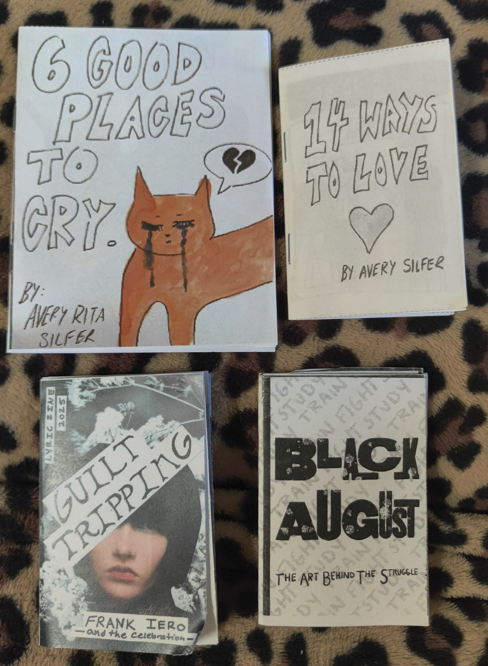
My zine haul

My History of Zines

I was first made aware of this thing called a “zine” when I started working on Ape Culture with Julie Wiskirchen. She wanted to create an online zine, not a magazine. So I purchased some zine anthologies (The Factsheet Five Zine Reader and The Zine Reader, Volume 5) to figure it all out. And then every time my friends and I visited Little India in the East Village of Manhattan we also visited a zine store that was in a basement a block down the street. There I found used copies of Bitch and Bust (both which turned into news-stand magazines at some point), 8-Track State of Mind and Beer Frame, some of my favorite zines at the time.

Then I created my own three Cher zines (which are huge, compared to a typical zine,  8x10s with 70-120 pages compared to most zines half to a quarter of that size with between 10-20 pages). My zines were hard to reproduce, especially as paper prices escalated over the years. I wanted to do 5 but only managed to finish 3. Now I’m facing technical challenges with Microsoft deciding to not support MS Publisher anymore, which was a high-tech way to create them compared to the cut-and-paste model of most zines. Now I’m trying to get my zines n PDF form to sell and distribute electronically instead. Very unziny of me.

Anyway, I love zines. As an opposing force to my interest in Digital Poetry is an interest in very crude, analog poetry and art (like cassette tape art, installation poems and DIY paper zines or any hand-made publications). I love to see what other people are doing with it, too.

ABQ Zine Fest XIV

Let’s start with the organizer’s table. First of all, I’m a sucker for buttons. The Zines No Maga buttons were free. This year’s fest button came in the screen printed pouch, a great DIY zine kit (oooh…an eraser in there too).

Another woman was selling DIY zine kits. I couldn’t resist that kind of generous offering from artist to artist. Below is a picture of the envelope and its contents.  That vendor also had a box that you could interact with and contribute notes to. I added my own. Maybe this box of content will end up in a future zine.

Some adorable little guys…

There was also a table of Marxist zines, most of which were free. I took three of those freebies and then as a gesture of thanks, bought the Anti-capitalist affirmations (which were great).

My main goal of the day was to find poetry or pop-culture zines, similar to my own projects. I didn’t see any pop-culture zines but I did find  a few poetry zines, including these three. The far-left one is from a group of artists who have monthly art meetings in their driveway. They then compile a  yearly zine compilations of photos, art and writing that they’ve shared with each other. I told the zinster that felt like a very COVID-era project but they said it was started later. The middle zine has writing from the Santa Fe prison and the far right one is from a poet who creates their own zines.

Another table had compilations of poetry and other art from prison-projects, too. These were $10 a piece and I asked her what her favorite one was and she found it hard to choose but finally said this one. She saw me combing through my purse for cash and said she’d take $5 but I inissted on scrounging together the full price. Nobody’s gettin’ rich on these zines.

Another woman did zines based on research she had done around New Mexican food. (!!) What’s better than a zine? A local zine. I would have bought all the zines she had, but restrained myself to these three:

One table was managed by a professor at UNM showcasing works from student projects. She also showed me this book of hers exploring alternative designs of a book, a “french door” inspired piece called “The Split” which is two sides of an argument that “comes together at the end.” Awesome!


My favorite zines were the ones that had this kind of “thinking outside the box” creativity. Two people had folded zines into those fortune tellers we made as tween girls with numbers and boys names written inside. (Image one and two contain the same zine about extinct birds.) And another used a gumball machine to distribute very tiny zines. That was my favorite. So creative and fun!

I also loved zines that used cut outs. And these were the zines I paid the most for. The pages of this purple zine had hand-painted watercolors,  cut-outs and that telephone pole page actually has string sewn in!

The New Mexico Birds was also a local topic, delicately made and hand drawn. And charmingly tiny!

One final interesting thing was how many of the zines in my haul (some of which I’ll be giving away) had music playlists included in the back of them. Two examples:

Frijoles and Folklore zine also had a whole tamale-making playlist with a great introduction. If you’ve ever made tamales from scratch, you know what an all-day, labor-intensive family event it is. One would need a substantially long playlist for it. Well, Aunt Toodles had one! This shows just how much music and cooking, (I myself love to listen to music when I cook), and music and zine-making go hand in hand. The author had two QR codes at the end leading to Spotify mixes but they are private and unsearchable from Spotify. You have to have the zine to access them. So perfect.

But there’s also something zinely analog about just having the paper list and searching for the songs one-by-one yourself.

I can’t wait until next year.

Developing Translations

I’m finishing up two other poetry books today, serendipitously both combined works of poems and essays, albeit each organized differently. One is La Llorona on the Longfellow Bridge, Poetry y ostras movidas by Alicia Gaspar de Alba and the other is Marilyn: Essays & Poems by Heidi Seaborn. For the most part, I have liked the essays better in de Alba’s book and like best the Seaborn poems that delve into Marilyn Monroe’s biography, although Seabourn’s investigations into her own personal insomnia are interesting, there’s just a lot of that to read through.

But last week I found out my friend, the poet Ann Cefola, has a new book of translations available with the French poet Hélène Sanguinetti, Alparegho, Like-nothing-else, so that book has been moved to the top of my to-read stack.

To launch the book Beautiful Days Press hosted a transnational, bilingual poetry reading between Cefola (in Long Island, New York) and Sanguinetti (in Arles, France) held on Zoom with attendees from all over the world.

The publisher began by quoting from prior reviews calling Cefola’s prior translations of  Sanguinetti “splendidly nuanced” and created “with scrupulous fidelity.”

Which sounds like well-made translations to me and I’m fascinated with this whole process of translation, especially as it was described in this Zoom reading.

Cefola talked about how Sanguinetti’s words have “muscle” and that “they struggle on the page.”

Sanguinetti and Cefola then each read the same section, first Sanguinetti in French and then Cefola in English, Sanguinetti beginning using a finger drum and that followed by a very impassioned reading.

I was able to attend the first Cefola/Sanguinetti reading years ago in Los Angeles for their first book-length effort (Hence This Cradle). Back then we gathered at the Otis College of Art and Design and it was 2007, which seems like many lifetimes ago in the world of Hélène Sanguinetti.

Based on the comments of the attendees on the Zoom call, I will be expecting a collection of experimental quest poems. One reviewer called it a mock-epic. Sanguinetti talks about the quest being the “adventure of our lives.”

After they both read from the book, one attendee said the poem was “lovely to the ear in English and French.”

When asked about how Cefola works with Sanguinetti as a translator, Cefola said “the tracks are there” and that she understood how different English was with its often harsh, Anglo-Saxon sounds. Her job was to mediate between the English and the French but in doing so she had to get “rid of a lot of prepositions that make French so lyrical and beautiful.”

Cefola said her first pass was to capture “accurate words” and then a second pass was made to choose words that “fit the sound,” words that would “resonate” with Sanguinetti’s French.

Cefola admitted she wanted to make Sanguinetti sound more lyrical in the beginning but Sanguinetti told her “this is not what I’m doing,” that Sanguinetti wanted “a struggle on the page” and so Cefola had to “let her work be difficult” and in doing so she had to “set aside [her] own traditions.”

Which is a larger exercise (and lesson) in human understanding and empathy.

Another attendee asked about the idea of a bridge being used as a symbol in the book and Sanguinetti talked about how it could illustrate courage and the unknown. Cefola later told me that “the broken bridge is also about the writing process” and how the “rider has to make leaps even if the way ahead is ‘broken.’”

Sanguinetti  says “Alparegho” is an invented word that is both “similar to myself” and “similar to nothing” and she talked about paradox, which feels like much of her work to me.

She noted with mild frustration that people have told her they understand her poems better when she reads them aloud. And the performance of her poems is definitely worth watching but the look of her words on a page is equally interesting.

She then showed us an abstractly human-formed sculpture. She said she makes objects with clay and plaster and this was a character she made covered in yellow acrylic paint with a bird’s head and horns. She said she gave it a red stain for a heart and added a pebble and a button. When it was done she asked it, “who are you?” And this figure became was a starting-point for her character Alparegho, “a point of departure, half sun, half moon.”

She talked about Alparegho rhyming with the word escargot (and how the book contains a snail’s journey) and the hermaphrodite nature of the character.

As an aside, this point of departure reminded me of Georgia O’Keeffe and how her paintings were often influenced by music. The O’Keeffe gift shops in Santa Fe and Abiquiu even sell a CD compilation of some of her favorite pieces, Georgia O’Keeffe, A Musical Perspective, which includes work from Bach, Beethoven, Schumann, Stravinsky, Copland, Schubert, Mendelssohn, Gershwin and Vivaldi. There’s also a Joel Goodman piece on the CD called “O’Keeffe’s Colors.”  I was disappointed the CD booklet did not (or could not) trace specific music works back to certain O’Keeffe paintings. But the bridges that form between music, words and art is yet another kind of translation that is fascinating, and O’Keeffe shared it with other painters, sculptors and photographers. She also developed close friendships with writers.

In a second question to Cefola, she explained more about her translation process, that she doesn’t read the poem in full in French at the begining, that she translates it as she goes, a very “basic translation” and that the poem then “develops like a photograph” in a darkroom.

“I see it as I translate,” she said. In the second pass, Cefola will “fine-tune” the meaning and the language “to convey the spirit to an English-speaking audience. She said “accuracy” was more important than any kind of “meaning” and it’s interesting to think about the fine-lined difference between those two concepts.

Sanguinetti then expressed her admiration for Cefola’s translations, called them “incredible” and said she felt they read better in English than in French to which Cefola interrupted with an emphatic “no, no, no.” Sanguinetti said there was sometimes a word or two that was translated in a way that gave an unintentional meaning but that through the translation process she often discovered aspects of the work she hadn’t seen before.

How great is that? Looking forward to reading this book.

More reviews and a synopsis: https://asterismbooks.com/product/alparegho-like-nothing-else

To see a recording of the book launch: https://www.youtube.com/watch?v=i8HPP10pdLk

Purchase the book here.

What is Poetry: Is Making a Poem Different From Making a Painting?

On we go through Elisa New’s questions about poetry from the Harvard MOOC on Emily Dickinson. This week’s question is, in full: “Is the making of a poem, that essential creative act, different from making a painting?” She goes on to wonder, “Is it different from playing an instrument? Does one, while making a poem, hold a little linguistic instrument while one makes a painting hold a little brush? Does one hold that brush in mental fingers? Ply language on some sort of cerebral tongue?”

This is a much more specific question than how poetry is similar and different to all the other arts. But as I said in the last Elisa New post, there seems to be more of a brain-to-body coordination necessary in fine arts like painting and sculpting or than in playing a musical instrument. Those all take physical and mental practice. Children learn to write pretty fast and it doesn’t take much time to learn to type on a keyboard.

Impulsively, conceptually, though, there may be similarities.

So da Vinci had opinions (as seen in the image above). Frank O’Hara also thought about this quite a bit, about the intersection of painting and poetry. Probably as part of his job description. He worked himself up through the ranks to curator at MOMA in New York City and was friends of many of New York’s abstract expressionist painters of the 1950s. Two of his painterly poems are “Why I Am Not a Painter” and “The Michael Goldberg Variations.” Funny I came across this later poem today because yesterday I finished The Loser, a novel by Thomas Bernhard which  features the Canadian pianist Glenn Gould and his performances of “The Goldberg Variations.”

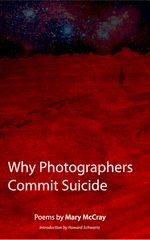
I also wrote a poem about the conversation between painting and poetry while I was a graduate student at Sarah Lawrence College (so this would be the mid-1990s at the house at the top of Brandt Terrace in Yonkers, New York), a poem that ended up in my first book of poems about space exploration to Mars, Why Photographers Commit Suicide (2012). I remember sitting on the floor writing this. The movie title, On a Clear Day You Can See Forever, was on my mind and Toni Braxton’s “Unbreak My Heart” was on the radio, which is where the bristle bone line appears. In fact, I think a workshop edit suggestion at the time was to change the verb unbreak to healing in order to further distance the poem from the song, which was getting a lot of radio play at the time.

On a Clear Day You Can See Jupiter

Mary McCray

Some nights when the universe dips in and out of my street
like a dancer, I can see Jupiter through my window.
And I wonder where you are and how things are for you,
like performing resuscitations on a dream.

And although we are together—fundamentally here
on the same hemisphere, you don’t have to answer me.
You don’t have to reply to this untethered planet heart.
It’s too late for us and I surrender to the war
of my fates—where poems burn into pieces of litter.

Take your watercolors and color my window with Jupiter.
Crack open the glass with your knives and turpentine.
Paint these words of mine, life-full of hue and value
and watch my heart healing like a bone
inside the tornado of a thousand bristles.

You don’t have to answer me. You just need to know—
on a clear day you can see Jupiter—in my eyes
and on your fingertips, where the universe
dips in and out of your street like a dancer,
in my words and through this window where I’m on the horizon.

I would probably change the bristles from a thousand to a hundred. That’s a bit much. As was the melodrama of too lateness already in my mid-20s. Wow. What did I know?

More conversation between O’Hara and his painters:

What is Poetry: Is Poetry Like the Other Arts?

Art, Artifice and Ancestry

“They seek and cannot find the meaning of the music.
We see only postures of the dream,
Riders of the motion that swings the face
Into view under evening skies, with no
False disarray as proof of authenticity.”

This is from John Ashbery’s greatest hit, “Self-Portrait in a Convex Mirror,” a great contemplation of art for any self-portraiture artist.

I guess you know when any blog post begins with an Ashbery quote, this is going to take a minute.

After a bit of a break we are moving on ahead with Elisa New’s questions about poetry from the Harvard MOOC on Emily Dickinson. This week’s question is about how poetry is like or different from the other arts. I started with this post last week and stalled after the brief categorical musings below.

I started  by listing out all the arts I could think of: the so-called plastic arts (3D things like sculpture), drawing and painting, photography, the fabric arts, music, film and animation, theater and dance and the writing arts. There’s also decorative arts (furniture and home goods), experiential art (like happenings), digital art (including game design) and fashion design. Some would include architecture. There are probably more I’m missing.

I guess the answer to a question like this is sort of hierarchical, (and I’m going to come back to this later), because on some level the impulses to make art are all the same. And there are mashups happening between all these art forms. So in that way, it’s very fluid.

You could argue that writing is very verbal and verbal arts would include poetry, prose, theater scripts, screenplays and the lyric part of songwriting.

Some physical artists use word play as well, either as abstract material or as literal content to add another layer of meaning to physical objects. Likewise, some writers work with spatial ideas on paper.

I’ve always thought writing entailed the least amount of physical skill. Many of the arts demand a good deal of hand-eye coordination. Magic fingers. The physical arts are very tactile obviously. Writing happens mostly up in your head.

Of all the arts, music seems the most abstract and nonverbal (apart from lyric writing). But many of the other arts can be plenty abstract, as can writing itself if words are separated from the things they attempt to signify.

And here is where I hit a wall last week. What else is there to say about this? I am always trying to figure out the buckets and usually find out buckets themselves are problematic. If you ever have to make an arbitrary bucket choice in your categorization scheme, something is wrong with your buckets.

Over the last few weeks, my friend Jen has been conversing with me over email about the 2024 Joni Mitchell book Traveling (Ann Powers) and about jazz fusion and purism. For example, in the book we learn that many jazz purists insist that what Joni Mitchell was doing was not jazz but jazz fusion. I was telling Jen today that I never really understood what the word fusion meant, (just one of those obscure jazz words, you know) before we started talking about it. And I went down a rabbit hole last week wondering about the other music genres. Did they all have a sort of renegade fusion gang pulling at their neatly sewn seams?

Like is there blues fusion? I often research Cher’s 1970s torch catalog for my other blog and many of those songs are defined as blues songs, but they seem more like pop/blues. Would torch songs be considered a kind of fusion?  Is there a rap fusion, a classical fusion (would Liberace sit here?). Does fusion just mean a mashup?

I was telling Jen today that I think my whole problem is that I can’t see the boundaries of anything. I really struggle with this. Music genres, movie genres, writing genres. Where are the boundaries of the western or  horror genres? How is a prose poem different from flash fiction?  What the hell is fictional memoir?

The Exorcist  is a prime example for me. It’s mostly a mid-1970s auteurist drama IMHO. I just Googled that term to see if it was a thing. Not only is it decidedly not a thing, but the first movie that came up for it was Al Pacino’s comedy Author! Author! which I love for predictable reasons: it’s got a dramatic actor in a comedy pretending to be a wacky family drama but is ultimately about a completely failed family system. What’s not to love about that??

But back to The Exorcist, which is a slow burning candle depicting mainly the breakdown of single, working mother with a few scary scenes thrown in that tap into the horror genre and were so remarkable that they captured our idea of what genre that movie was.

It’s very fuzzy for me, as you can see. And so when anyone exploits the complexity of the buckets we’ve culturally created, (with a comedy horror or a western horror movie, for example), I’m delighted. I’m in my space.

And I think my problem with buckets is not just because I overthink my buckets (which I do), but because of the way my brain works to categorize anything. Should we categorize the Lucky Charms marshmallows by color or shape?

But also I struggle for a plethora of other reasons, like living through postmodernism, being part of the Gen X group, influences I have encountered starting with my father, who himself organically resists buckets and loves both Lucinda Williams and ABBA songs.

As I was thinking about all these issues: fusion and types of art, I was also working to understand my poetic ancestry. Poets like Joy Harjo have been calling for poets to create a written genealogical chart of our writing influences. And I’ve been having trouble with this, too, because I’ve been mistakenly focusing on my teachers and mentors, who did influence me but not really my taste (or lack thereof). I kept trying to draw up from Howard Schwartz to his teacher and then up to that man’s teacher, all the way back to Theodore Roethke. But that never feels right. I don’t think my experiments are really related to those people at all. They were just guides and mentors, (versus textual influencers), trying to help me do my own thing not something like their thing. My poetry is really nothing like Howard Schwartz’s or Theodore Roethke’s poetry.

When I’ve talked about my interest in Queer Culture, (most recently in my Cher blog), this has probably been my greatest influence. Even if you’re not LGBTQ+, you can have a queer sensibility, (see the book Camp Grounds, David Bergman). And I think this has to do with the gay male culture I’ve been exposed to as a Cher fan and my sympathy not only with those artists politically, but very importantly aesthetically. And the aesthetics very broadly include camp, drag, the celebration of guilty pleasures but also the idea of textural resilience and bullying, and as a woman who was pressured in many ways to be a “sweet Mary,” the tools of subversion.

So this morning I was reading an essay on the New York Poets (Frank O’Hara, John Ashbery, Kenneth Koch, Barbara Guest and James Schuyler), and I realized I was unavoidably influenced by these poets (and a plethora of ancestors between them and me) and their ideas of genre fusion, their slippages in tone. Were they being serious or funny in their poems? Were they making fun of pop culture or revering it? I feel I can fundamentally understand that they were doing both at all time. Because I too, cannot fairly see the boundary between comedy and drama or pop culture and anything else. And it’s not surprising that the two pillars of this school (Ashbery and O’Hara) were gay men.

The New York School poets targeted the boundaries between high and lowbrow art, including poems that reference movies, symphonies, French fiction, pornography, epics, cartoons (this is Brian M. Reed’s list from this morning’s essay in The Cambridge History of American Poetry)…and most famously abstract expressionists paintings.

Reed goes on to say these writers adopted “the same impassioned tone toward both elite and popular culture which can leave a writers taste level in doubt, as well as lead to a reservation considering his or her fundamental aesthetic values.”

Or I would argue a reservation considering the idea of fundamental aesthetic value itself.

Or the fact that some of us can only see one bucket.

Later Reed says, “the poets permit themselves to scramble, invert, reinvent, and otherwise tinker with every available discourse without respecting any of them as sacred or outside the limits…[and they] exalt in this freedom by making artifice and artificiality a central theme in their work.”

Later Reed says the New York School poets would also “draw attention to the problem of artifice, probing its zero degree, the boundary between art and nonart.”

So this problem is hierarchical, we can see again. Where is the boundary between say rap and pop or comedy and drama? Then where is it between movies and photographs? Between poems and song lyrics? Between high and lowbrow? Between art and nonart?  The good and the bad?  A yen and a taste? The opinions of ourselves and the opinions of others we love and admire? The border between the self and others period?

It all feels irrelevant then when you can’t find the edges.


The sculpture at the top is “Rethink Plastic” is by the artist Javier Jaén.

What is Poetry: Deliberate Craft Controlled by the Maker

We’re working through Elisa New’s very interesting questions about poetry from the Emily Dickinson Harvard MOOC. The next question is a big boy: “Is poetry a deliberate craft controlled by a maker?”

And here I think Elisa New is asking about how much control we have over our creations, how much of the poem comes from inside us versus how much comes from something outside of us. And this is really a spiritual (and biological) question about where our consciousness begins and ends.

You might believe you are a singular entity, biologically and mentally speaking, or you might believe you are part of a larger system of energy or thought.

I personally am agnostic in pretty much every spiritual sense: not ruling anything out but not fully accepting of any belief system. I’m spirit-curious, as it were. Non-committal. I have commitment issues, religiously speaking. I was raised by one stalwart atheist and one reluctant atheist.

I believe it was the writer Will Storr who said it takes just as much faith to believe in ghosts as it does to not believe in them. And you could pretty much take that perspective to any kind of spiritual dilema.

Anyway, as it pertains to writing and creative thinking, I have had three kinds of experiences around this.

1) Writing with the conscious mind: this includes a conscious effort to brainstorm, organize, draft and edit work.

2) Subconscious accidents and architectures: these are unplanned things that happen but that are traceable back to training, experience, expertise and other subconscious activities happening in your own brain. Sometimes natural, serendipitous connections and subconscious decisions are made with details and architectures.

3) Outside contributions: here is where it gets a bit spiritual. Some writers believe in a real external muse, a mystery or a loved one or maybe input from God or ghost writing. Poet James Merrill believed his content was being provided by a Ouija board in his book The Changing Light at Sandover and poet Jack Spicer was another major poet who believed language was “dictated” to him and he was not “an agent of self-expression.

This question has prompted me to go back through my own experiences in writing poems (from high school to now) and make a survey of my various “phases.”

High School Phase in St. Louis: this was my first, exploratory, practice of poetry (reams of it!) handwritten in notebooks, a lot of high-school love stuff and play with free association. It’s marked by a lack of training and very little reading of other poetry. And not a lot of thinking about how creativity works.

Undergraduate College Phase in St. Louis: these were my first advanced classes in the explication of literature, my first poetry-writing workshops, the happy discovery of writing mentors/teachers (the first encouragements I received to continue on). I started to meet other poets (amateur and professional), started to read poems (contemporary and the canon). This period was marked by my revolt against the idea of a poems written in a series (no idea why; it seemed pretentious) and embracing metaphorical writing, especially the extended metaphor poem. My word choices became more conscious as I had discovered the magical uses of a thesaurus. All this was firming the muscle of my conscious writing skills.

Graduate School in Yonkers: I was getting continued encouragement and realizing I was wrong about the series-based poem thing. I actually loved doing series work and would continue to do basically that going forward. I was also learning to write narrative poems (the Mars poems) and telling small stories. I was doing more conscious-writing skill-budling.

Post-Grad School in Los Angeles: here I started a deep dive into Buddhism and Zen Buddhism and was developing an interest in telling my family history on my father’s side, having an epiphany of confluence for those two interests while reading Zen and the Art of Falling in Love by Brenda Shoshanna, which eventually resulted in the cowboy book. The family history got dropped and I was practicing more long-form narrative poetry instead. This to me was some unconscious work starting to happen, some happy accidents, integrations and conflux of various separate interests and ideas.

Writing in New Mexico: this period is marked by starting on the NaPoWriMo challenges while I was temping at the Institute of American Indian Arts in Santa Fe. These were yearly explorations in form prompts and series poems on speed. After moving to Albuquerque, I started to take MOOC surveys on the history of American poetry, the final phase being “Electronic Poetry” or digital poetry after which I began exploring browser-based poems.

Now, from the beginning to this point I had never experienced anything like writer’s block on any writing projects except maybe day-job assignments in marketing (which were miserable experiences). For good or bad, I’ve always had plenty to say, a lot of obnoxious opinions. Maybe once in a while I’ve had a problem with a plot point or a spot of rhythm or word choice, usually needing help ordering a series or a book. For spelling and punctuation, I will always need another set of eyes (if I can find them).

But here is where it starts to get weird. For all the NaPoWriMo projects from 2013-2021 and including 2024, the writing was mostly directed  by me. I had complete authority over those poems (in my mind at least). There were some subconscious happy accidents, some parallelism I didn’t consciously intend or a clever plot point that designed itself.

In 2021 I started what turned out to be a two-year project of dictionary poems. This was a project inspired by Lohren Green’s Poetical Dictionary (2003) and I had assumed I’d have complete authority over not only the the containing poems but the words themselves.

I soon found out that I was unable to insist upon any of my own words. If I picked out a word I wanted to use, I would always get writer’s block. This was the first time in my life experiencing a block over anything. What the hell! I could pick as many words as I wanted but poems went nowhere over and over again. There was no rational argument I could make to the mysterious muse.

And it’s not like words just came to me from the outside. That didn’t happen either. I would come up with a few words every few days and a voice (that didn’t seem to be me) would almost nudge me with an encouraging voice telling me that “maybe you should explore that word.” And I would have to wait for that nudge or I couldn’t proceed. So f**king weird. And I had no control over how often words would be sort of “approved” by this voice. How frequently they would come or not come.

At the same time I was working on another series, NaPoWriMo 2022. I was pretty busy doing that and hoping to put the dictionary poems on hiatus. But that month a large bunch of dictionary words came in a fury and I found myself often posting two poems a day, one NaPoWriMo poem and one (or more) dictionary poem. It was crazy-going until I finally appealed to the voice (or whatever it was) to stop sending me dictionary words.

Almost in a huff, the words stopped and they stopped for what seemed like months. Was this myself in a huff with myself?

I can’t characterize much about the voice but it almost seemed to have a gender and an age. But hey, let’s not go there.

For that NaPoWriMo year in 2022, I had a similar but not identical experience with “the voice.” These poems were based on pop and rock songs and I did determine (for the most part) which songs I was going to write about. I also felt I had authority over the hook for each poem and their narrative direction.

The voice (and it did seem like the same voice) appeared only to help me with particular problems. For example, I had a big problem with the poem for the song “Ne Me Quitte Pas.” That poem was a hot mess involving literally a shipwreck. Figuratively, the poem was a wreck itself. I opened up my mind to suggestions from outside of myself and I received back the idea to use Theodor W. Adorno’s famous quote about “there can be no poetry after Auschwitz” as a alternative guiding principle for the poem. Big help. Thank you very much.

Similarly, I became stuck with the poem for the song “Could It Be Magic.” I couldn’t get a direction or any traction with it. All I knew was that the poem was half-written and I got very angry every time I worked on it. Why was I getting so angry? Then one day while I was in Cleveland, Ohio, visiting my parents an answer popped into my head like a gift.

It was the song making me feel angry. Incredibly, the response I needed was not only the answer to my question, but it was the answer to the poem and the whole set of poems. It was amazing!

In another section of the set, the muse was completely unhelpful. I had a placeholder song for a poem (and a placeholder story to go with it) that I did not want to use. I wanted to use another song by that artist but I couldn’t yet find it. Also, the story was too enigmatic. It didn’t fit with the other more direct poems in the set. I was blocked again.

I opened up again for help. The voice returned but this time with an adamant no in response. The voice said unequivocally, “this is the song and this is the story you get.”

Well, I couldn’t believe this was true. Surely, open-mindedness would prevail and another song by that artist would come with and new idea, just like it did for those other problematic poems. This artist had many songs, after all, and I had months to prepare. As the day of publication kept getting closer, I felt nervous but never resigned. I kept checking in; the voice kept saying no. This is the song; this is the story. So aggravating! Up until the day of publication, I kept hoping for a new idea and that voice never waivered. To this day, I see that poem like the flaw in the Navajo blanket, the open door that defines the whole set.

I have not experienced either of these experiences since those projects of 2021 to 2023.

And I can’t honestly tell you I even believe in this voice or the idea of an external muse. It’s not very rational and human perspective is so limiting and easily misled. Maybe I just have a very active imagination. Maybe I have a deep, subconscious creativity.

Maybe the longer you practice writing, the more deeply you go into your thinking mechanisms and the weirder that might seem. On the other hand, maybe the longer you practice writing the more you are able to tap into intelligences beyond yourself.

So in answer to this question of whether poetry is a deliberate craft controlled by its maker, I really couldn’t say.

What is Poetry: Language or Music

We’re working through Elisa New’s very interesting questions about poetry from the Emily Dickinson Harvard MOOC. The second question is really two of her questions: “Is poetry native language at all? Is poetry a kind of music?”

We’ve argued about this previously, most notably when Bob Dylan was awarded the Nobel Price in Literature in 2017. Well, I guess it was just me arguing with the points made by New York Times poetry critic David Orr. I can’t paraphrase it all here. Suffice it to say I’m suspicious of anyone who thinks poetry is not music and language both.

The use of “Native” is interesting in the first question. Does this mean pre-language versus learned language, like toddler-speak? Or does it mean pre-history language like petroglyphs? Or some kind of under-language that is always with us, some emotional language?

Poetry for me has a pretty big umbrella and it involves an implication of permanence. I mean every writer intends a kind of permanence for their work, (a possible stay against death), but poetry tends to have a greater shot at a longer shelf life. Poetry is not inherently disposable like, say, political opinion or podcast reviews. The topics are more universal, the tone meant to strike more deeply into the psyche.

I am always considering the place of petroglyphs as poetry, too, and our hesitancy to label American Indian verbal rituals as poetry. Unlike verbal ceremonials, someone took the time to write out concepts in petroglyphs. I have some petroglyphs on the hill behind my cul de sac. And as far as “native” language goes, (in all senses described above), they “feel” like poetry to me. They explore something intellectually serious and they strive to be permanent.

Often they intend to commemorate a special occasion or idea.  As does music.

Poetry has always challenged the boundaries even poets have tried to attach to “poetry.” Poetry should this and poetry should that. Always they are trying to contain the idea of poetry around themselves, their work or their taste. Musicians do this, too. Maybe so did the petroglyph writers. Humans love to tell each other what to do.

Is poetry simplified language? Except that it can be delightfully complex and convoluted. Is it a simplifying of our experiences? Except that it can illustrate the complexity of our experiences. Is it elevated language? Except that it can be coarsened language. Is it a narrative? Except that it can be non-narrative. Is it form? Except that it can challenge the idea of form.

It uses words. Except sometimes it tries to loosen words from their moorings. And it can be gibberish. It can be written in any language system (petroglyphs). It can be pictorial sometimes or can employ the same intention with symbols (petroglyphs).

It is not music. Except that it often is imbued with music. It’s almost impossible to separate poetry from any trace of music, any occurrence of rhythm and rhyme.

It may even be a third thing, a hybrid teetering in-between and pulling from native pre-language, sophisticated layers of modern languages and also ice-skating with tropes of music. If not an in-between thing, it is maybe an ever-morphing thing that grabs from all of its neighboring communication systems. It is possibly undefinable.

We could let it go, this attempt to nail it down. But tell me what’s the fun in that?

What is Poetry: What is it Made Of

(Atom sculpture)

Years ago I took some Harvard MOOCs (Massive Open Online Classes) with Elisa New. And during the class on Emily Dickinson she went through a list of very interesting questions about poetry.

She noted that certain Dickinson poems theorize about “what poetry is, what poetry is made of.” And then New goes on to ask multiple questions around the substance and boundaries of what poems are, what poetry is.

I’ve collected these questions and we’ll be exploring them for the rest of the year, starting with the opening inquiry: what is poetry made of…

….which you can’t very well answer, by the way,  without speaking figuratively.

I would answer this by saying poems are made of heart and brain matter, the substance of yearning, suffering and joy, the desire to nail down the salty, sugary in-betweens-ness of our lives.

It is made of nothing from the periodic table of elements, not even the breath or paper it finds itself delivered upon. It is both a voice and not a voice in every sense of the word. It has no DNA or nucleus.

It has a big charge without any atoms.

It has no matter and yet it does.

Poetry is one of the only human things on Earth not made of carbon.

And this reminds me of a love poem from my first book, Why Photographers Commit Suicide, “Monogamous Carbon: A Classified Ad” written back in the early 1990s when I lived in Yonkers, NY, and was writing science poems for my MFA at Sarah Lawrence.


Literary Recipes

I’ve been meaning to do this post for many months now but was unable to carve out the time. Recently, there was an Intro to Anthro With 2 Humans podcast about Roman food (“Pour Some Garum on Me“) and just like the Egyptian sex poems book, I was able to find literary crossover as a stream of books come through the house.

As I flipped through one book called Gastronomical Time Travel, I also happened to be reading The Alice B. Toklas Cookbook and I realized some of these recipes were related to famous literary works.

So I thought I would list some of them out.

Absinthe

I visited an Absinthe bar in Paris in 2008 and since then I’ve been noticing references to absinthe in paintings, novels and biographies. Painters and writers include Edgar Degas, Édouard Manet, Henri de Toulouse-Lautrec, Paul Gauguin, Paul Verlaine, Picasso Vincent van Gogh, Arthur Rimbaud, Baudelaire, Ernest Hemingway, Guy de Maupassant and Oscar Wilde.

Absinthe recipe

The Mint Julep

The Mint Julep was made famous in F. Scott Fitzgerald’s The Great Gatsby. Here’s a Medium article on “The mint julep’s jaunt through literature.”

Mint Julep recipe

The Madeleine

The Madeleine is probably the most famous depiction of food’s impact on memory and the sublime, from Marcel Proust’s novel In Search of Lost Time: Swann’s Way.

Madeleine recipe

New England Clam Chowder

New England Clam Chowder as depicted in Moby DickI’m going to Boston in early August and hope to have some thick, creamy New England clam chowder!

New England clam chowder recipe

Fried Chicken, Cold

Cold Fried Chicken appears in many novels from Pride and Prejudice to A Moveable Feast.

Make the fried chicken recipe, then refrigerate.

Haggis

From the Robert Burns poem, “Address to a Haggis.”

Poets love to write about food. Here are 10 anthologies of poetry about food:”10 tasty food poetry anthologies for hungry readers.” I have The Hungry Ear which has anthologized food poems by contemporary poets.

Haggis recipe

Oysters Rockefeller

In The Alice B. Toklas Cookbook, Toklas talks about Toklas and Gertrude Stein’s return to America from France in 1934-5 and their discovering the new foods Americans were eating. One of the dishes was Oysters Rockefeller and Toklas captured a recipe for it. Mark Twain was also extremely fond of oysters in any dish, including the Oysters Rockefeller.

The Decades-Long Comeback of Mark Twain’s Favorite Food

Oysters Rockefeller recipe

More Lists of Literary Foods

The End of NaPoWriMo

A little bit of catchup to do. I was in Cleveland for a month dealing with some family stuff. And then my dog. And then my computer. And then my sanity.

New Mexico Poetry

When I arrived home from Ohio, sitting on the doorstep, (literally), was the Albuquerque anthology of poetry, Open-Hearted Horizon, from the University of New Mexico Press. This was the first piece of good news I had had after many, many days of increasingly bad news.

I knew the book was coming out sometime this spring but I hadn’t heard an update since the fall of 2023, including any news of the book launch party which happened in March while I was gone.

Sigh. My streak of being unable to network with local poets continues.

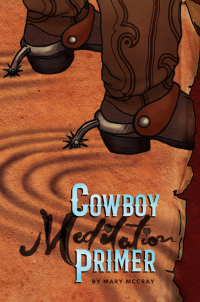
But two of my poems made it into the anthology, including one from each of my books, Why Photographers Commit Suicide and Cowboy Meditation Primer. I’m very excited about reading this collection, which includes some famous local poets and Joy Harjo. To be in an anthology with her is pretty awesome.

This book will also be included in an upcoming page I’m working on that will be an ongoing roster of poetry anthologies and poets who write about New Mexico. I have a shelf of these books! It’s the kind of page I wish I had found when I moved back here in 2010 and was looking for examples of how poets write about the place to understand how I might do it.

You can buy Open-Hearted Horizon from the University of New Mexico Press page or from Amazon.

NaPoWriMo 2024

This was my last year doing the challenge as I’ve hit the goal of over 300 poems (311 to be exact). Quite frankly, I’m shocked I was able to get this year’s challenge completed, almost without a hitch.  I say almost because on the last day,  (April 30), I accidentally copied over the poem prompt from the day before, (for April 29), with no backup available locally or online. I hadn’t yet printed off the set and had kept no offline copy. Why I forgot to do this? I have no idea but it’s a great example of  the precariousness of NaPoWriMo challenges because almost every poem starts that morning without much pre-writing. So I literally had to re-invent that entire prompt from scratch.

I guess it’s surprising this had never happened to me before in all the 11 years of NaPoWriMos. It was an almost miraculous bit of luck that I was able to slowly remember most of the poem. Unfortunately, it’s not an exact copy. I know a few lines here and there are missing from the summary and the poem. It was an interesting mental experience to crawl back into the flow and see what memories came back in what order, the most recent memory being a missing piece that woke me up very early this morning  and I kept mulling over whether the line was “instead of someone to  spend all this time with” or “instead of someone with which to help spend all this time” or finally “instead of someone to help spend all this time” and then I fell asleep and forgot it all over again and had to start all over when I woke up again, the second time finally scribbling it down on a piece of paper in the dark and then going back to sleep again.

This last challenge is interactive with 30 multimedia prompts covering food, handwritten postcards, music, maps and scavenger hunts so you can write along. I had really no idea how each poem would go each morning, with the exception of the Winslow weekend posts which I had to preplan.

Here is a summary of the last 11 years of NaPoWriMos:

2013-2017 and 2019 can be found (somewhat degraded over the years) on Hello Poetry.

If you’re interested in interactive poetry projects, you can also try the 52 Haiku prompts.

The NaPoWriMo poems will stay up for a little while until I find the time to edit them better and compile them into a book. The nature of this challenge is that poems are quickly scrawled off and edited only within the span of a day. So they will be improved before their final resting place.

Winslow Writer’s Trip

One of the things I’m grateful for right now is being able to have taken a writing trip to Winslow, Arizona, a week or so ago. I so needed it. The trip was to meet up with the Sarah Lawrence College off-campus writing group that started in the early 1990s at the house where Murph and Denise’s were living in Bronxville.

Over the years we have stayed in touch and a few years ago we started a reading group to tackle Infinite Jest. We kept going after that. Last August, when I visited New York City, we met for dinner and agreed to meet again in Winslow in 2024.

We caught up on life stuff, writing projects and generally became a closer, fiercer gang of writers. It was perfect, aside from the fact that three of us miscalculated the time-zone change driving back east to Albuquerque and I had to floor it to get them to the airport to catch flights back to Philadelphia and New York. Good times.


To be honest, I almost decided not to finish the NaPoWriMo at all. This spring was so rough I was very much feeling like “what am I doing all this for?” But then I decided I would get to the 300 poems done if killed me. It did not kill me. But I have some quiet reflection to do right now.

« Older posts

© 2026 Big Bang Poetry

Theme by Anders NorenUp ↑