Reinventing the Life of a Poet in the Modern World

Category: Poetry Technology (Page 1 of 9)

Tech Fails and The Malevolent Provocateur

I was in a team meeting  a few months ago and my boss noticed, apropos of nothing, that my name, Mary McCray, has, (eerily and evenly), two Ms, two As, two Rs, two Ys and two Cs. Like my whole name is a duplication of the letters M, A, R, Y and C.

And then he searched for annograms of my name and the one that best described this strange situation was “Marcy Marcy.” He jokingly found said this was probably messing up the matrix.

I said that sounds bad but just add it to the pile of all other things.

Sigh.

Breaking the Spiritual Matrix

I’ve been sitting on this post for months. Months! It felt too depressing to post. Not that I’m above (or below) posting gloomy. When the time calls for. Because I like a good grouse as much as anyone. But this one felt really complain-y.  And how useful was that?

It’s basically about all the tech fails happening all around us (and what this means for creative people). And I’m not just talking about new tech problems, like A.I. or the  occasional A.I. “hallucinations” although those are kind of batty when they happen. Asking A.I. to explain who Mary McCray is has been both fascinating and disturbing. For one thing, A.I. thinks more highly of me than I think is true. I had a book club meeting and we’re all writers so we talked about that and I’m convinced A.I. is trying to ingratiate itself by blowing smoke up our asses. And then just the wrongness. For example, A.I. had me co-writing a very famous song. And aside from helping my brother get out of a lyrical dead-end once every few years, I’ve never written a song in my life.

But I’m not talking about all that. I’m talking about tech things that have been working forever and suddenly they are not working…and nobody knows why or how to fix them anymore because systems and technology have become too complicated to unravel and fix. So the problems are left just languishing out there in the open like abandoned motels on the side of the road.

Wholesale things on websites, like links and redirects not working. Email confirmations not working. Phone apps not working. Virus scanners getting confused. Phone trees breaking down. My text app can’t handle group threads anymore. And it’s been broken for over a year. Business processes breaking the minds of the people and machines tasked with following them. It’s like we’re arriving at a tipping point where technology is doing more harm than good and people are dumping their “smart” appliances for “dumb” ones….just to be able to, for example, do their laundry.

The amount of phone apps we are required to have just to make hair and doctor’s appointments, get grocery store coupons. Not only are we having storage problems, but the elderly can’t fill out copious amounts of pre-visit online forms when they can’t understand the ten steps needed to access them.

A recent airline ticket QR code stopped working for me 30 minutes before a flight and the flight attendant has to print a ticket off for me. Like on that amazing technology of paper.

A doctor I’ve been trying to see finally cancelled my appointment this month because they can’t navigate my insurance situation. They tried for six months and finally we both gave up.

What a mess everything is.

And then there’s this thing they are calling a decline in our attention span. I call it becoming illiterate. Over the years, I’ve watched a very, very smart friend struggle with any kind of longform reading at work. When a long email comes to this person, they struggle with “too much information” and the bullying “wall of text.” It’s like all the microcontent we have consumed over the years has made my friend illiterate.

People are losing their jobs just as paywalls are going up everywhere for formerly free services.

Technology has suddenly become very political.

All of these are major tech fails. And I’m not the only person to notice. Everyone is noticing it.

Good ole Yankee ingenuity, our historical faith in labor-saving devices. Innovation and invention, fads, disruption and planned obsolescence, our obsession with the youth is really an obsession with the new. These are all American themes.

But for the last few decades, technology has been disrupting the wrong things. Why not disrupt health care and the fiasco of health insurance? Why hasn’t anybody taken that on? Imagine the countless amount of suffering that could have alleviated.

But hey, we can shop with our voices now and we don’t have to use our fingers! Next day shipping! Credit card information is saved for all future purchases on any website. We can send our friends money easily now!

Do you see a pattern here?

What is the utility or efficiency of having people forced to be ambidextrous between Mac and PC, Apple and Android? There is none. Why should developers have to design things that need everlasting updates. As we’ve seen with digital art, artists and writers can’t keep maintaining their pieces out from eventual technological obscurity.

You now need a gazillion programs to do your job (even toilets are getting complicated) and none of them sync seamlessly with any other. There’s always a glitch that requires manual intervention and workarounds. I have a whole separate tirade I could make about how work tools have mostly made work tasks more difficult and time consuming for us. We’re doing so much babysitting with the tools, we have less time and brain capacity left over to solve the real people problems our jobs are trying to manage.

TV apps have made TV watching too complicated. To reinstate my AppleTV account takes a phone with a QR code app (that never works), a URL to use on my phone or computer, then a verification number sent to my phone and then a password to get into my website account. So there are many walls I have to scale just to give AppleTV my money. And it’s been that way for years. They’re not trying to fix real problems.

Disruption a big word in technology. It’s a goal for designers and “visionaries” but it’s been a nightmare for real people, especially older people. One of my parents has cognitive issues switching from one streaming TV app to the other (let alone dealing with their four separate remotes) because each one functions differently. As technology continues to make our lives more complicated by the day we’re starting to see that cognitive breakdown creep into younger and younger minds, like my friend above with the reading issues.

If you can’t get your washer and dryer to run because the internet is down, that’s a tech fail. If technology puts people out of work and makes them go hungry, that’s the biggest tech fail there ever was. And the biggest irony is that layoffs are beginning first with the very technology employees who have been designing our human obsolescence.

Benevolent vs Malevolent Provocateurs

I want to talk about the idea of disruption because I hear a lot about it. And not just in technology. It’s a big word for writers and artists, too. It’s just not called “disruption.” But it’s been on most writers agenda since modernism. Shake it up. Helping people is never on the agenda. Not really. Not truthfully. It’s the drive to be known as the person who shook it up.

Figure out a way to disrupt the canon, a way to challenge allegedly complacent people. The most respectable artists have been considered provocateurs. And it’s been so culturally and socially admired, everyone wants to do it now.

And it’s just not scalable, socially or morally.

I was at a party a few months ago and there was a libertarian there who we all like and who is a very smart and funny person. He was talking about trolling his co-workers on Facebook and he said, “I just want to fuck with people.” And I wondered, to what end? To get them to “take themselves less seriously,” he said, very seriously.

I recently read an essay about John Adams and how he predicted that conflict that would keep America on track (conflict, adversity) and not community and stability. This was because, he believed, it is simple human nature to want to be in conflict. People naturally are needy for recognition, wealth, and to feel they are better than their neighbors. They will conflict to attain.

So I try to understand capitalism’s insatiable need for a constant newness and the tech sector’s constant drive toward disruption and society’s decades-long-march toward the pinnacles of every conceivable thing, from singing contests to baking bread to winning a dog on a reality show.

My party friend just wants to fuck with people. But to what purpose? Later in the night he admitted he left a job because he felt he was being, in so many words, fucked with.

So rule number one is if you’re going to be one of those people who fucks with others, you better be amiable when being fucked with. But that never seems to be the case. Rarely are the shit-starters fit enough to have shit started upon them.

And I keep coming back to the impulse to do it. To what purpose. Can you articulate how society will be improved based upon your fuckery? And it better be good, because everyone and his dog are doing it.

If the answer is “I don’t know” or “I don’t care, I just like to fuck with shit,” that’s the definition of malevolent provocateuring. If you just want to cause people to feel like shit because you are annoyed about something (like political correctness) or the opinions of somebody else, that’s not good enough. It’s just “shit rolls downhill.”

If you can articulate an outcome that (1) is not all about you and (2) is actually an improvement to a problem of the human condition, then that is benevolent provocateuring.

To what purpose is your fuckery?

There’s so much of it everywhere you look that to truly be unique these days you need to go completely the other way. That’s where the real risk and adventure now exists, to go up against those who constantly feel the need to go up against everything else because they feel bad and cannot regulate their feelings.

Mostly I feel disruption is just malevolent manipulation, to confound for the sake of confounding. The world shits upon me so I shit upon the world. I have been disrupted and therefore so shall you be.

I’m telling you, you can’t stand out in all this shit. The only resort to distinction now is the impulse toward continuity, consistency, kindness and peace.

I know what you’re thinking: this is why we can’t have shitty things.

So what does this mean for literature? 

Utility in Art. That’s a strange concept.

W. H. Auden once said, “poetry makes nothing happen.” Maybe he’s right; but until the end of days we’ll never know for sure.

For a long time we’ve been experimenting with disruptions. I like experimenting too. There’s nothing inherently wrong with it. It should still exist. But there’s no law that says art can’t be useful: emotionally, philosophically, spiritually and practically.  It has the potential to improve your life. It can do anything. And it can do anything because it’s an easy and open vessel. You can put helpfulness into it just as easily as you can put spite and rage…and fuckery.

For decades we have been asking readers to put up with more and more disruption. For what gain? Look deeply into your own heart.

In a world of the manipulation and disruption and planned obsolescence, utility seems completely revolutionary.

ABQ Zine Fest 2025

Been living here for 15 years now and I’ve finally managed to make it to the Albuquerque Zine Fest. Well, for the first few years I was in New Mexico, living in Santa Fe, I didn’t even know about it. It wasn’t until I had been living in ABQ a few years and started working at CNM that I met a comic book artist named Peter who was working in our marketing department. He is involved in some local comic events and knew about Zine Fest from the crossover.

But even still I was never able to make it there until this year. And it was fun!

I found it impossible to be choosy with my zine purchases (a few dollars here, a few dollars there),  mostly because so many creative things were being done. In fact, I missed about three or four rooms of zines just by being overwhelmed with riches in the main room. I never did even open up the zine map provided by the organizers. But that was probably just as well considering I ran out of money before finishing my spin through the main hall.

Even though many zinesters took credit cards and Venmo, I wanted to stay in the analog world of cash…because that’s so zineish.

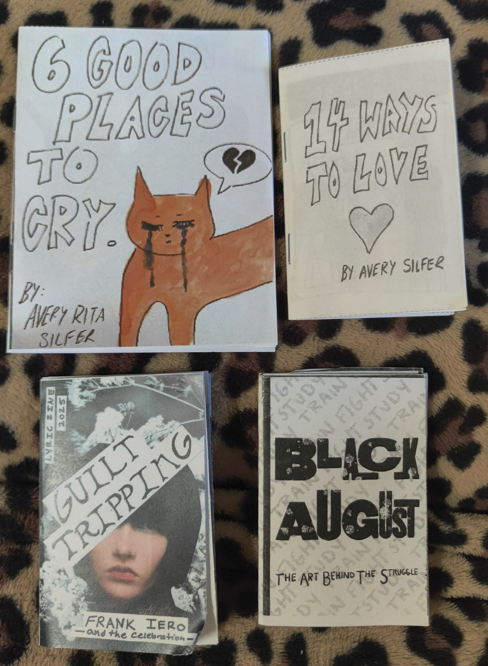
My zine haul

My History of Zines

I was first made aware of this thing called a “zine” when I started working on Ape Culture with Julie Wiskirchen. She wanted to create an online zine, not a magazine. So I purchased some zine anthologies (The Factsheet Five Zine Reader and The Zine Reader, Volume 5) to figure it all out. And then every time my friends and I visited Little India in the East Village of Manhattan we also visited a zine store that was in a basement a block down the street. There I found used copies of Bitch and Bust (both which turned into news-stand magazines at some point), 8-Track State of Mind and Beer Frame, some of my favorite zines at the time.

Then I created my own three Cher zines (which are huge, compared to a typical zine,  8x10s with 70-120 pages compared to most zines half to a quarter of that size with between 10-20 pages). My zines were hard to reproduce, especially as paper prices escalated over the years. I wanted to do 5 but only managed to finish 3. Now I’m facing technical challenges with Microsoft deciding to not support MS Publisher anymore, which was a high-tech way to create them compared to the cut-and-paste model of most zines. Now I’m trying to get my zines n PDF form to sell and distribute electronically instead. Very unziny of me.

Anyway, I love zines. As an opposing force to my interest in Digital Poetry is an interest in very crude, analog poetry and art (like cassette tape art, installation poems and DIY paper zines or any hand-made publications). I love to see what other people are doing with it, too.

ABQ Zine Fest XIV

Let’s start with the organizer’s table. First of all, I’m a sucker for buttons. The Zines No Maga buttons were free. This year’s fest button came in the screen printed pouch, a great DIY zine kit (oooh…an eraser in there too).

Another woman was selling DIY zine kits. I couldn’t resist that kind of generous offering from artist to artist. Below is a picture of the envelope and its contents.  That vendor also had a box that you could interact with and contribute notes to. I added my own. Maybe this box of content will end up in a future zine.

Some adorable little guys…

There was also a table of Marxist zines, most of which were free. I took three of those freebies and then as a gesture of thanks, bought the Anti-capitalist affirmations (which were great).

My main goal of the day was to find poetry or pop-culture zines, similar to my own projects. I didn’t see any pop-culture zines but I did find  a few poetry zines, including these three. The far-left one is from a group of artists who have monthly art meetings in their driveway. They then compile a  yearly zine compilations of photos, art and writing that they’ve shared with each other. I told the zinster that felt like a very COVID-era project but they said it was started later. The middle zine has writing from the Santa Fe prison and the far right one is from a poet who creates their own zines.

Another table had compilations of poetry and other art from prison-projects, too. These were $10 a piece and I asked her what her favorite one was and she found it hard to choose but finally said this one. She saw me combing through my purse for cash and said she’d take $5 but I inissted on scrounging together the full price. Nobody’s gettin’ rich on these zines.

Another woman did zines based on research she had done around New Mexican food. (!!) What’s better than a zine? A local zine. I would have bought all the zines she had, but restrained myself to these three:

One table was managed by a professor at UNM showcasing works from student projects. She also showed me this book of hers exploring alternative designs of a book, a “french door” inspired piece called “The Split” which is two sides of an argument that “comes together at the end.” Awesome!


My favorite zines were the ones that had this kind of “thinking outside the box” creativity. Two people had folded zines into those fortune tellers we made as tween girls with numbers and boys names written inside. (Image one and two contain the same zine about extinct birds.) And another used a gumball machine to distribute very tiny zines. That was my favorite. So creative and fun!

I also loved zines that used cut outs. And these were the zines I paid the most for. The pages of this purple zine had hand-painted watercolors,  cut-outs and that telephone pole page actually has string sewn in!

The New Mexico Birds was also a local topic, delicately made and hand drawn. And charmingly tiny!

One final interesting thing was how many of the zines in my haul (some of which I’ll be giving away) had music playlists included in the back of them. Two examples:

Frijoles and Folklore zine also had a whole tamale-making playlist with a great introduction. If you’ve ever made tamales from scratch, you know what an all-day, labor-intensive family event it is. One would need a substantially long playlist for it. Well, Aunt Toodles had one! This shows just how much music and cooking, (I myself love to listen to music when I cook), and music and zine-making go hand in hand. The author had two QR codes at the end leading to Spotify mixes but they are private and unsearchable from Spotify. You have to have the zine to access them. So perfect.

But there’s also something zinely analog about just having the paper list and searching for the songs one-by-one yourself.

I can’t wait until next year.

Big Data Poetry Studies: Poems in Newspapers

So a few years ago I bought a 2-year subscription to a Penn State journal called Studies in American Humor. I now have about four issues and I’ve only read one of them so far. They’re very dry. And less funny than you would think.

This would show I do not actually ‘subscribe’ to the idea that to study comedy is to kill it. There is no small amount of the unknown about art and our responses to it, but to me the mysterious element just proves (like the mysterious universe itself) that we just haven’t studied it enough.

Anyway, one of the journal articles inside Vol. 7, No. 1 proved very fruitful for this blog. It was called “Viral Jokes and Fugitive Humor in the Nineteenth-Century Culture of Reprinting” by Todd Thompson (2021).

Because we can now study large sets of content electronically through searchable databases, we can see patterns we were never before able to see. We call this “distant reading” as opposed to a “close reading.” And this author here was interested in how jokes travel from newspaper to newspaper across the United States in the 19th Century. For example, “one viral joke was reprinted more than a hundred times in American periodicals between 1856 and 1877.”

Scholars and anthropologists can now do this research with recipes, old songs, marital advice and even poems, as we will see below. Many of the more popular items “circulated for decades.” And we can now see how content often needed contextual understanding from the audiences reading them.

The joke Thompson studies is called “A Yankee Boast” or “Not to Be Outdone” and his whole effort here was based on a poetry study already done on searchable databases called “Fugitive Verses: The Circulation of Poems in  Nineteenth-Century Newspapers” by Ryan Cordell and Abby Mullen.

The basis of the joke was “a friendly argument between the United States and Britain” that first appeared in the Boston Transcript on 24 December 1855 and the gist of it was how Americans can get ridiculous in the game of one-upmanship. Constance Rourke describes the situation: “Half bravado, half cockalorum, this Yankee revealed the traits considered deplorable by the British travelers; he was indefatigably rural, sharp, uncouth, witty. Here were the manners of the Americans!” The joke plays on “the aggressive exaggeration about frontiersmen’s superhuman abilities to conquer their natural surroundings in the service of westward expansion and empire building.”

And the joke kept getting resurrected in bursts as the United States expanded, for example when the U.S. annexed Alaska. In the essay on poems below, the authors call this “multiple waves of popularity.”

The joke “elides the fraught politics of expansion in the late 1850s” and traces how the joke changed over time in reprints, by accident or by editorial interference, in one case eventually being used to make a serious editorial case in favor of manifest destiny.

And when studying a piece contained in a larger newspaper, the frame of content around that subject matters, so Thompson also studies where in the newspaper this joke would appear, what page, what ads and editorials where nearby, “how a joke’s meaning shifts….based on its collocation with other news items….the joke’s relative elasticity allows it to mean something different to readers who consume it alongside one or more…recurring themes.”

He also studied historical humor themes: “Comic exaggeration and the immensity of America’s natural features tended to go hand in hand in nineteenth-century American humor.”

So then I went to JSTOR and downloaded “Fugitive Verses: The Circulation of Poems in  Nineteenth-Century Newspapers” (which appeared in American Periodicals in 2017).

And this study was interesting to me for one reason: most poetry studies I read deal with the meaning or the development of a work in the literary canon as it exists appreciated in modern times. Okay, well maybe someone will sometimes delve into an obscure artist, but even then everything is based on our sense of taste today either collectively or individually. Rarely have we gone back to see what people found interesting in their own historical culture.

Often you see lists of names, long forgotten poets who were allegedly hugely popular during their day, but never anything much to explain or quantify the context of their popularity.

Distant reading can help with that.

And just as Thompson did with the American/British joke above, Cordell and Mullen follow the changes in poems over time. They explain how people once would cut poems out of newspapers and make scrapbooks from them. I would imagine they did this with jokes, songs and recipes, too.

The first poem they track is “a largely forgotten nineteenth-century poem” called “The Children,” a poem “not collected in The Norton Anthology of American Literature,” i.e. the canon, “but it was exceedingly popular in its day…reprinted at least 171 times…between September 22, 1864 and December 3, 1899, making it one of the most widely reprinted poems from the nineteenth century.”

A funny thing seems to happen when a poem gets reprinted so many times in so many places. It takes a life of its own through “remediation” and the poem separates from its author (often being attributed mistakenly to the wrong people or as an anonymous poem). The author loses the thread.  Even for kingpin poets like Henry Wadsworth Longfellow, America’s best seller. Even his poems lost track of him occasionally.

These were “messy realities of nineteenth-century print culture.” There were “mistakes of fact or typesetting that ripple through the newspaper exchanges, to debates over authorship.”

Sounds fun.

And again, context supplied additional meaning. Was the poem printed on a literary page or on the front page surrounded by related news. Imagine that, a front-page poem!

Anyway, “The Children” was written by Charles M. Dickinson. Foreshadowing that this familiar name would complicate authorship someday, as well as Dickinson’s use of a pen name sometimes. Most early reprints of the poem had the author mistakenly listed as “Dickens,” some as “Dickinson,” some as “The Village Schoolmaster” (his pen name) and some as anonymous.

And then a false story went around that the poem was found on the desk of Charles Dickens when he died. Sounds far-fetched but most people believed that story as it was reprinted so often.  As a Charles Dickens poem, the poem took on extra meaning because you would naturally attribute Charles Dickens’ literary preoccupations to it.

The authors quote D. F. McKenzie to label that kind of meaning-making “the poem’s social text.” And unfortunately the way people read the poem also started to affect how readers then viewed Charles Dickens.

This is how the poem becomes “fugitive.” On the run from its ownership, “that it has escaped its owner” and begins “circulating surreptitiously.”

This seems like a nightmare for anyone who has the idea of a romantic auteur about themselves. But “the nineteenth century developed the nearest thing that publishing poets have ever had to mass readership…the broadest and least controllable distribution channel for poets during the period…a highly variable network over which typical literary authorities had little say.”

So yeah…a mixed bag.

Authors protested misattribution but those protests appeared mostly in literary magazines and books; and who reads those?

And poor son of Charles Dickens who kept having to say the poem was not written by his father and having to write “a large number of letters” over “seventeen years” to try to clear up the mess.

This is funnier than the Yankee Boast, to be honest. But I’m saying that from 2025.

The article then traces another poem, “Mortality” by Scottish poet William Knox that was first printed in the U.S. in 1832 and got confused as a poem Abraham Lincoln had written just because he liked it so much. Through recitation and reprinting, stanzas got omitted and words changed. The most popular version should maybe be considered a “reauthorship,” according to this essay. And then after Lincoln died and the poem was included in his biography, the title was changed to “O Why Should the Spirit of Mortal Be Proud” which caused a further shift in the poem’s meaning.

And then poems were often printed with little editorial intros which affected how they landed in readers’ minds.

“Between 1859 and 1895, a poem named ‘Beautiful Snow’ circulated through more than 276 periodicals, across continents and across oceans.” It’s a poem the authors say is not found in any scholarship or anthologies but was a very popular poem about a fallen woman; and for years editors and readers debated its potential authors among actors, socialites, newspaper editors, writers and prostitutes.

“One British paper wryly observed, ‘In the United States of America there are 6,000 people who wrote the poem “Beautiful Snow” under a nom de plume, and they are increasing at the rate of forty-three monthly.'”

Cue the parodies. This poem became so talked-about that it was called “a beautiful vagabond” and “not a poem, but a series of events.”

To paraphrase the authors, poems that were printed in newspapers had a life of “uncertainties and slippages.”

So there was no easy life for poets back then as now. Imagine this: you might have the most popular poem of the today but then it would be attributed to Taylor Swift.


You don’t need JSTOR, you can read a draft of this article: https://viraltexts.org/2016/04/08/fugitive-verses/

What is Poetry: Should Poetry Be Heard or Read

We’re making our way through Elisa New’s queries on what poetry is, questions she posed in the Harvard’s Emily Dickinson MOOC. Here’s the next question in the list: is poetry language other human beings necessarily hear or read?

It’s interesting that New specifies “human beings” because obviously animals overhear poetry spoken by humans, like a racoon stuck in an attic overhearing a poetry reading downstairs. It must sound like pure music for them, like listening to any unfamiliar language. But it’s humans who need to experience their language as poetry or want to. And there are humans who are satisfied to experience poetry simply as nonverbal music. Fans of Gertrude Stein, for example.

New also specifies the word “necessarily” as if this is the way we have to experience poetry, as a necessity, and the other way is possibly superfluous.

It’s probably not necessary to overthink New’s casual questions here but the fact is the hoomans have never been able to agree on an answer.

Some of us believe poetry is best experienced as spoken word. Poetry is primarily aural in this case. Some of us believe the page is where the poem is set in stone and formalized. And the page itself, the white space, the visual is crucial to its meaning.

And they both have a point here. Much depends upon what properties of a poem the author was working with, sound or visual tricks. It’s hard to bring visual chicanery to life in a spoken performance. On the other hand, you can get a slight idea of the sound effects when reading a poem silently, but you get a better understanding of them when you read a poem out loud.

Poetry predates printing and so spoken word and memorization is at the heart of its history. Musical elements made it easier to perform and pass along poems. Often, it’s the musical elements that set poetry apart from prose.

But then the printing press happened. Poems could come alive in the minds of readers and not just in the ears of listeners. Now we have even newer publishing platforms like web browsers and interactive applications.

In one MOOC I attended on Electronic Literature, the teacher talked about “affordances” which were like beneficial properties of any one platform. For example, you can take a book to the beach, get it wet and it won’t conk out on you. It’s still a very usable media platform even when damp.

On the other hand, a book in an e-reader might short-circuit when wet, but is weightless and doesn’t take up room in your house if you decide to keep it. You can also search it for content very effortlessly and quickly.

Likewise, our mouth is a platform with some very beneficial affordances.

Everyone has a greater need toward one or another affordance. I personally like the look of books in my rooms. I like the feel of books and paper.

Interestingly, I was going to search images for this post, one for “poetry reading” (as in the live event) and “reading poetry” (as in the book). But the search engine, of course, didn’t know the difference. So putting the words “poetry” and “reading” in the search field brought back everything and that is kind of metaphorically nice.

These are pretty stereotypical images of both options. The dark room with a spotlight and a dramatic performer gesturing with their hands. Contrast this with the manicured reader, enjoying nature no less with a latte with some artfully applied whipped cream.

So every one will have their own personal answer to this question; and how could it be otherwise? We all have different aesthetic needs.

For me, music itself satisfies my need for music. And the music of poetry often overwhelms me during poetry reading performances. The rhythms send me drifting off into my imagination and I come back a minute or two later having missed whole sections of the poems. There’s also the poetry reading grunt that I find pretty grating.

But then again I love to attend public discussions of poetry and literature, like the sessions of The Los Angeles Festival of Books and I like Ted Talks and stand-up comedy. So I do like the physical human presence of communication. It’s a fine line between that and other forms of spoken word.

I’m much more interested in poetry as a visual artifact. So for me, the page trumps the performance.  Whereas for the live performance of a conversation, lectures or the performance of music itself, this is not the case.

Music has such a strong nonverbal element, regardless of its lyrics, a strong energy of spirit (in all its variation). Poetry, albeit with its own kind of spiritual effect less powerful, is more verbal and idea-based, despite experiments exploring the boundaries of that with either nonsensical or mostly musical writing.

For me, music does music so well. And reading platforms give poetry more opportunities to do what it does so well.

Learning New Things

I am still making my way through a year’s subscription of New Yorker from 2021 but I only have a few issues left. I came across a good article last week called “Starting Fresh” by Margaret Talbot and it’s about learning new things as an older person and how this is good for preventing cognitive decline. This article interested me for a few reasons:

One, the women in my family have always been keen on preventing cognitive declines. My grandmother Ladd did this by religiously doing crossword puzzles and keeping track of storyline plots of soap operas. My mother does it with online games like Words With Friends, and cooking when she is able to still do that.

Secondly, I had a brain explosion many, many years ago when I took a ceramics class and got over the daunting idea that I would never be good at it. (See raspberry mask above.) We live in a society that instills in us a terror of attempting anything we might fail. So most of us like to stay in our comfort zones.

But as a writer working my way through my later years, I feel the need to keep exploring, as best I can anyway. This article talks about the benefits of learning new things later in life beyond the spiritual resetting of embracing a beginner’s mind. And also of the dangers of perfectionism earlier in your life.

“Maybe it could be an antidote to the self-reported perfectionism that has grown steadily more prevalent among college students in the past three decades. Thomas Curran and Andrew P. Hill, the authors of a 2019 study on perfectionism among American, British, and Canadian college students, have written that “increasingly, young people hold irrational ideals for themselves, ideals that manifest in unrealistic expectations for academic and professional achievement, how they should look, and what they should own,” and are worried that others will judge them harshly for their perceived failings. This is not, the researchers point out, good for mental health. In the U.S., we’ll be living, for the foreseeable future, in a competitive, individualistic, allegedly meritocratic society, where we can inspect and troll and post humiliating videos of one another all the live-long day. Being willing to involve yourself in something you’re mediocre at but intrinsically enjoy, to give yourself over to the imperfect pursuit of something you’d like to know how to do for no particular reason, seems like a small form of resistance.”

Yes it does.

Talbot talks about what kinds of cognitive abilities decline with age and which ones improve with age. There’s no perfect age, as it turns out, for the best cognitive ability in all areas. “Fluid indigence, which encompasses the capacity to suss out novel challenges and think on one’s feet, favors the young. But crystallized intelligence–the ability to draw on one’s accumulated store of knowledge, expertise and Fingerspitzengefühl—is often enriched by advancing age. And there’s more to it than that: particular cognitive skills rise and fall at different rates across the life span…”

The article states that your overall cognitive function will also improve if you try to learn a few new things at once. You don’t even have to be good at it. Just the attempt to do it. And researchers think this is because the act of learning multiple things at once replicates how children learn.

I’m fascinated watching how children learn things cognitively and socially. Following early child development educator Dan Wuori on Twitter is just as interesting as watching people try to solve mysteries or design things on TV. It’s watching the wheels spin. You can see it on countless reels of little kids. The first Dan Wuori video that hooked me was a little kid learning how to sort bags of different kinds of snack chips and it was compelling. The face of someone thinking is a wonderous thing.

Which is all to say I’ve started learning how to type on a braille typewriter I bought a few years ago. Back then I invited a friend over who works at a local school in Albuquerque where kids have some disabilities. So she has to take a braille test every year. It was a daunting lesson. First we had to figure out why the machine wasn’t working. Then she had to show me how hard it was to use!

I did a series of typewriter poems a few years ago and it took me like 60 pieces of paper to type out 6 poems. But I’m a comparatively good typist so that was easy compared to working with braille. There’s the same high expectation that there be no errors, (no white out sheets for my typewriter poems!), but you have to learn to type very slowly with multiple fingers engaged for every single word.

It took me quite a while to write a poem I thought worthy of the thing. Years. Then I used an online text to braille translator to map out the poem this week. Now it’s just days and weeks ahead of making many mistakes.

Wheeee!

Board Game for Poets

This amazing world, huh?

In August my friend Ann told me about a poetry board game called Dead Poets Rise, a game that was not yet for sale. I sat across from Ann practically losing my shit. A board game for poets? I’m a poet! I love board games!

I tried and failed to get in on the funding by sending a message to the game Facebook page. Possibly I was too late, but I did get added to the mailing list. The game went on sale  last fall for $100. This seems like a steep price when you consider games going for $20-40 on Amazon and Target. But I’ve noticed really popular and well-designed games are going for $100 on eBay, games like The Gallerist (about planning art exhibitions at your gallery and rumored to be the hardest strategy game out there, a factoid told to me by one of the clerks at my local board game hangout) and Shakespeare (where similarly you plan out a theatrical show).

This is a very nice game and I can see why it’s listed at that price point. I got a copy as a Christmas gift. Thanks Mom!

The Stuff

It’s a beautiful game in an awesome hexagonal-shaped box. The only flaw is that the box doesn’t close properly and needs a paper strap that’s hard to get on and off to keep it closed so that the contents don’t all spill out when you try to stash it in your closet. The paper is already tearing and will give up the ghost before long and I’ll have to be careful with storage. Right now the game is not being stored with my other board games but with my conspicuous poetry consumption objects.

The cover also acts as a hexagonal board with quotes printed along the edges. There are also juicy elements like a die, three decks of cards, tons of marbles! And a board that looks like Chinese checkers. Also included are mechanical pencils (with little eraser hats and a box of replacement graphite), pads of paper and a sticky notepad for all your writing prompts.

You also need a phone to look up texts and videos as part of the writing prompts.

The instructions

The instructions attempt to explain in words how to set up the board but we had no idea what we should end up with. The instructions need a picture of the board at the start of play. The main issue was that there were too many marbles for the available marble holes and we needed to have a combination of black and green marbles. But how many black marbles did we need? The instructions didn’t say. And should there be more black marbles in games with more players? There were black and green marbles and big shooting marbles (to represent the players). Shooting marbles went into easily marked holes around the edges of the board. We just had to guess.

Instructions should be specific about how many black marbles to “roll out” per number of players and then instruct the players to fill in the rest of the holes with green marbles. Why were there so many bags of marbles in the first place? There was a nice tan bag full of big beautiful shooter marbles, a beautiful black bag with the game logo full of green marbles. Then there was an extra plastic bag of 12 black marbles and another extra plastic bag containing 4 green and 2 black marbles. We never did figure out what all the different bags meant.

The black and green marbles were referred to as common and uncommon marbles which seemed unnecessary. In fact the game had too much new terminology that was maybe intended to create ambience in the game but it ended up just being confusing.

Instead of getting a specially made single die with low numbers, the instructions had a die translator. This annoyed me more than it did Monsieur Big Bang who was playing the game with me.

A word about Monsieur Big Bang, he hates board games. He grew up with bar games like pool and foosball, not that he’s crazy about those games now either (maybe with the exception of pinball). During Covid I got into board games somewhat excitedly. I focused on finding 1) games I felt deprived of as a child like Mystery Date or Go To the Head of the Class, two games my girlfriends had, 2) detective games with map boards and 3) games with pictures of famous art or art-related games (which is a crossover of #1 and the fact that my eldest brother had the game Masterpiece and refused to play it with me for mysterious reasons so I’ve been obsessing about that game ever since.

A word about me: I am notoriously bad at board games. I just like the doo-dads, setting them up, sorting it all out, losing the game and then putting everything back in the box. Just typing all that out makes me want to do it right now. My eldest brother did play games with me from time to time, but only war games like Risk or Battleship, during which he famously won by lying for the whole game and I guessed every single space until it was impossible not to have hit one of his ships by then. I lost by gullibility but then he was 7 years older than me so…I don’t feel too bad about that.

Getting Monsieur Big Bang to play board games is always a struggle, especially these days because he is very busy. And my local friends have their own games they want to play, so I’m collecting quite a stack of unplayed board games. I even bought one called Plunder with a pirate raiding theme (and little tiny ships with attachable masts and cannons) thinking it would entice Monsieur Big Bang (who also used to like Risk) but that was a no go. One of the last games I made him play was the aforementioned Mystery Date. I had a few friends who had this game but they never wanted to play it (also mysteriously). It has such an awesome opening door feature and I was always wanting to play it.

It turns out my girlfriends didn’t want to play this game because it is mind-bogglingly boring and takes too much time around the board before you can ever get a chance to actually open the technological marvel of that door to reveal your date for the night. I recently snared a copy and talked Monsieur Big Bang into playing it and (can you believe it?) I kept losing this game too! He kept getting the ball-room prince and the ski hunk and I kept getting the ‘dud,’ by which the game just means disheveled guy.

Oh yeah, so another annoying thing about Mystery Date is that is was created in the late 1950s and has seriously outdated ideas as to what makes an attractive date for the typical 1970s little girl. Twenty years later and that ‘dud’ looks pretty much like the most attractive guy in the deck and the others look like the duds.

But that doesn’t change the fact that I’m not very good at board game strategy. And this game would prove no exception, professional-poet expertise aside.

Dead Poets Rise has two stacks of Creation and Chaos cards. You use them to write a poem while your working to collect marbles on the board.

Creation cards give you prompts for lines of your poem. Chaos cards sabotage the directions you were headed with those lines.

Examples of Creation cards: use the words always, never, sometimes in your next line, use alliteration with pr, pl, gr, gl sounds, search Google with provided prompts for words, write about a smell in the room, write about two disparate objects in the room, fill in this sentence when I hear ambulances I want to ….

Monsieur Big Bang said at this point the game felt like a Mad Lib.

Examples of sabotage cards: change one of your words to the opposite, change your verb tense, change the past to the future.


Unfortunately, there were quite a few duplicate cards and some triplicate cards. Coming from a family of poker players who can do fancy acrobatic playing-card shuffling, I can tell you I also suck at card shuffling. So I have to shuffle like ten times and still we couldn’t get them shuffled enough to reduce the duplicates  We also caught a typo in the word ‘corresponds’ in one of the cards.

Hopefully these things will get rectified. All the prompts should be original.

We played the short game for two people. The object is to roll the die and move across the board collecting a certain amount of black and green marbles. Once you have all your marbles you can move into the center area of play called The Sphynx Challenge.

Each turn also draws Creation and Chaos cards that help each player create a poem in the style of one of the “dead poets,” obscure poets that comprise another, most interesting deck.

You actually start things off with this dead poet deck, which includes separate little packs containing a handful of cards each for one obscure poet. At the beginning of the game, you all agree on the poet and everyone pulls a poet card with some biography and samples of poems. The players also choose a random theme from a list in the instructions. You use the theme and the poetry samples to write “in the style” of the poet you are attempting to “resurrect.”

It sounds more complicated than it is.

The back of the dead poet packs have biographical information and each player gets one of cards with snippets of their poems on it. These are the cards we drew:


By the time of The Sphynx Challenge at the end, you have pretty much a completed poem and the challenge is to read one line of your “fake” poem lines and two lines of the real poet’s poem and others have to guess which line is yours.

We each guessed each other’s fake lines.

In fact, Monsieur Big Bang won on the technicality that he was the first to make it to the Sphynx area with is big marble. And our decision to have him guess my fake line was just courtesy play.

The punishment for losing the Sphynx challenge seemed too much for the short version of the game (three green marbles) but then again your marbles don’t win you the game so who cares.

The Sphynx challenge introduced the elements of points which seemed sudden and out of place and the game provided no material to track these sudden points (grab a piece of paper). It felt like an after-thought, an additional confusion. And yet those points would determine the winner as people won or lost the challenge. Then again, it was also possible we weren’t playing it right. The whole points layer was confusing.

At the end of the game, we felt like the game was missing something and I couldn’t articulate it. The box had all the do-dads, after all.

Monsieur Big Bang had some ideas though. He said you could almost dispense with the board play and use the card prompts for writing exercises, like for students, friends or just playing alone. He said it was lacking a sense of a game’s highs and lows. There was no real feel of competition. And so we discussed board games that lacked this competition element and yet were still fun, like the Encanto movie board game. In that game you work together against a clock to save the house. It’s still fun but not cut-throat.

My friend Julie recently gave me a very Dungeon and Dragons like haunted house game, Betrayal at House on the Hill, (which I haven’t found anyone to play with yet), and the first half of that game is cooperative to set up the board pieces and the second half of the game, once the monsters get tripped off, is competing against a common monster and against each other.

Dead Poets Rise did feel like a writing exercise more than a game. I also didn’t understand the rationale for collecting the marbles except to extend our writing time with the prompt cards. The game does seem to needs more conflict, if not against each other than with some external element.

Monsieur Big Bang also felt the game didn’t have enough person-to-person contact. And you didn’t feel invested because there wasn’t enough drama, which prompted a retelling of the the joke I learned at Sarah Lawrence, “why are poets (and thus poetry board games) so cut throat? Because the stakes are so low.”

The stakes felt very low for this game. And maybe that’s where game drama lives.

The final imposter challenge did seem most satisfying at the end and maybe that could be worked into  regular game play. Considering it was one of the most fun aspects of the game, it was disappointing that the first person to enter the final Sphynx challenge area quickly won the game before anybody else could experience the fun of being an impostor.

I also really liked discovering, if not feeling like I fully “resurrected,” the dead poet. Our poet was Celia Dropkin and our theme was “the war within.” I had never heard of this Russian-born Yiddish poet who immigrated to New York City at the turn of the century (and passed away in the 1950s) so that was great fun for me (more so than for the non-poet-player).

Although there are some fixes needed, I do want to emphasize it’s a fun box of beautiful things and I will be playing it again and showing it to other poets.

My resulting poem turned out like this:

Untitled (the task of adding a title could be added to the play somehow)

Maybe my mother’s yearning
is never in me like conception (Not a bad start)
and the silence of the Gods gone quiet
like all the fires of the world going out,
grounded, groused and groveling for air. (What a mess of a run-on!)
And to survive I strive to organize. (True, dat)
When I hear ambulance I want to
melt into the water like ground (Good prompt to switch those words)
where the italicized roots of Latin are buried. (I had to change roots to monks. Boo.)
And the world revolves on the sight of glass
and dollars and dead poets. (I like the end)

And So the Summer Departs

To-do List Courtesy of Reddit

It’s been a while since I’ve posted an update here…well since our Essay Project came to a close in July. When I finish a big project I always feel suddenly a little untethered.

Alarmingly, this year has gone by faster than any year before (it would seem). Cruel summer and turned into cruel fall. Soon it will be Christmas and New Year’s Eve. The Halloween stores are already open and just a moment ago  it was spring and I was finishing up migrating websites. The whole year was on the horizon and my day job was really feeling great. (They gave us ice cream!)

The year of 2023 has brought me….well, things. For one, the day job has turned into the gaslit labors of Sisyphus. And the somewhat dreadful news about Artificial Intelligence has taken a lot of wind from the sails of my proliferating digital poems.

I spent a few minutes yesterday with no small bit of ennui considering if I’ve actually accomplished anything this year.

But I have.

I’ve finished two multi-year online blogging projects on Cher Scholar and we’ve wrapped up the Essay Project here. I did create a few new browser-based poems  and the The Electrical Dictionary of Melancholy Absolutes hit 100 definitions quite unbelievably this week.

And the in-progress stuff continues to march along. Although it’s been a slow slog, I’ve been working on a big course-like survey about the poems of American history. I stared about two years ago and I’m just now seeing the finish line. Monsieur Big Bang’s new Intro to Anthro podcast has me thinking about what format that survey course will take. Should it be a podcast or an online class? Should I use an educational platform for a fee or just host it myself for free (like a podcast)? I still don’t know. Podcasts have higher visibility but that format leaves out the possibility of fun PowerPoints and videos of petroglyph from my neighborhood. In any case, that’s a decision probably a year or two away.

The Katharine Hepburn poem is underway and slowing forming into itself. I’ve also started a new browser-based poem about my paternal grandfather based on some work my brother Randy finished a few years ago researching the history of our grandparents in Jicarilla, San Carlos, Hopi, Tohono Oʼodham, at the Indian School at Stewart, Nevada, and their final years in Roy, New Mexico.

I also need to dust off the Braille machine I purchased a few years ago and figure out how to write poems on that thing.

I have a little stack of experimental poetry books to review going back to last fall of 2022.

There are some fun trips ahead, too. Our group formerly known as the Sarah Lawrence writing group, now known as the Difficult Book Club, held a reunion dinner recently in New York City. It was so much fun, we’ve made plans to meet again in Winslow early next year.

And I have poems forthcoming in a spring 2024 anthology of Albuquerque poets coming out from University of New Mexico Press.

It’s a lot of work. I’ve made a big change in my day job hours that will go into effect at the first of the new year and hopefully that will give me more time finish all of this stuff. There’s that novel too.

So I guess that’s good, right? I feel like I’ve hit a plateau somehow. Oy. These are times for baby steps.

Anyway, in other news my friend Christopher gave me this book for my birthday, a coloring book created by Jane Heyes, peppered with Shakespearean, Romantic and 20th Century British poetry (except for one Walt Whitman poem floating in there, “A Glimpse“).

Maybe I should spend a few months just coloring around poems like I’m William Blake

AI Aiyee!

I’ve been telling people this week about what a dumpster fire my life is at the moment what with various things going awry, (job things, neighborhood things, sick friends, old dogs, and many, many more).

For example, I wanted long hair when I was young and my mother would not allow it, mostly based on her own aggravating childhood experiences of her mother brushing her long hair while she practiced piano but also because she said she knew me very well and I would never brush it. And if I didn’t brush it, spiders would nest in it. That’s what she said.

I thought, hmmm…not a deal breaker.

So what happens this morning? Ok, she was right. I don’t brush my hair very often, but seriously? I suppose you could say this is a dumpster fire of my own making but that’s not the point. The point is, that spider could have picked any other week to go for my long, unbrushed hair.

So anywho, I’ll be using a few dumpster fire pics to describe the new normal for poets and other writers in the shadow of Artificial Intelligence, another dumpster, another fire.

Everyone everywhere is talking about Artificial Intelligence, or AI, and the astounding (and creatively off-putting) gains it has made in the last few months with the release of ChatGPT.

When I was last in LA in April, my friends and I went to the Marina del Rey restaurant Dear Jane’s and our friendly waiter there,  (who had just moved to LA from Atlanta), told us he was using ChatGPT to write a script for a sitcom about a restaurant where he was once employed. He said he just plugged in all the characters and some scenarios and bada-bing-bada-boom! The script was done.

Forget for a moment the cliché that every waiter in LA is writing a Hollywood script. We have more pressing problems.

I also have a friend from Sarah Lawrence who now works as an editor at a very prominent magazine in New York City. She told us the writers there are being told they have to use ChatGPT for first drafts (save us all time, you know). The writers there are very unhappy about it. Even the young digital natives are upset. Everyone can see the writing on the wall here.

For years, we’ve been letting AI learn from us everywhere from Grammerly to auto-correct to auto-suggest. And we’re so cheap and frugal. We’ll happily be lab rats as long as the App is free. As they once said in the documentary, “The Social Dilemma,” if you didn’t pay for the product, the product is you.

So here we are. Flood under the bridge.

I’ve been saying for years writers shouldn’t feel so threatened by AI since nobody wants to hear what machines have to say. We’re human beings wanting to connect with other human beings about the human being experience. I was even reminded of this while attending my niece’s graduation from Perdue in Indiana last month. We talked about AI there too. At dinner when someone suggested the commencement speeches might someday be written by AI, everyone noticeably cringed.

The table was full of engineers who had plenty to say about AI. First the engineers informed us it was really machine learning we’re talking about, not AI. (I still don’t know the difference.) My brother Andrew, his ex-wife Maureen and her best friend are all computer engineers and they had a mini-debate at the table about whether or not we could use tools to detect things created by AI.

That debate started because I lamented AI would probably affect all future literary submissions to magazines. Now this is one thing I hadn’t thought about before when I insisted people don’t want to hear poems, music and stories created by machines. We still don’t want to but what we want only matters if nobody ever lies.

And as we know, people love to lie.

So, for example, how will a literary magazine be able to tell, post ChatGPT, whether a submission has been written by a human being or a machine? We’re on the honor system now. And the problem is letting machines write your poems is easier than doing it yourself. And we all know people who care more about getting published than they do about authorship in the first place. Why wouldn’t they let a machine try to create something that would get their name in print and then just lie.

I didn’t think about the lies.

How do we even prove we’ve created something? I’m imagining a scenario like Melanie Griffith in the movie Working Girl where she’s explaining to Harrison Ford the long and winding way she came up with her business idea to prove her boss, the lying Sigourney Weaver, did not.

And what’s to stop a literary magazine from one day deciding to let a machine write the whole thing? It’s a lot easier than dealing with those pesky, needy writers. And who would even know? Who would even be able to tell? Do we even have the time to even try to figure it out?

My brother thinks we’ll soon have machine tools to be able to suss out tell-tale markers of creative AI content. My other brother Randy then said “But won’t AI then just get smarter to outsmart the tools?” To which Andrew replied that the tool will just get smarter then too.

Oy. Sounds like a lot of work.

And then having worked in the Internet business for a while myself, I can see how even AI might not be able to slog through the onslaught of information burying us these days, (AI could process it but could it find what’s meaningful for us?)  or even more distressing, I can see how one bug in the program could cause a lot of damage. Happens every day. We’re not smart enough to make perfect AI. (Although some day AI could be conceivably smart enough.)

Some people are even worried AI could cause not only the loss of all our professions, but the demise of humanity itself! Some alarming scenarios are proposed in an article in this week’s The Week. I’ve been talking about some of these apocalyptic scenarios with my Dad (a former computer hardware mechanic and software programmer) for years. But he sides with the machines! “Good-bye to bad rubbish,” I think he said. No help or sympathy there.

I spoke to my cousin Mark about it last Saturday. He says what I hear most of my writer friends say, “I’m just glad I’m at the end of my career and/or life.” But if you believe at all in reincarnation, you’ll probably just get reborn decades down the line, right back into this flaming dumpster fire so that’s not a real hope of escape. Besides, I’ve got maybe 40 years left if my family genes hold up. I’m not planning on retiring from creating.

My cousin Mark also said he’s heard about people  forming communities around the idea of only consuming creative material made before 2023. And honestly, if each of us just tried to consume the mountains of creative material at our disposal made before 2023, we’d never run out of music, poems, fiction, movies, or TV shows. We’ve surely got enough stuff.

But that’s still not very comforting.

Creators might have to live with creating on a much smaller scale, with just a small circle of readers. Because the joy of making art isn’t just in consuming it. Humans love to make it. Making it, in fact, might be the most pleasurable part. And at the very least, we know whether we made it or not.

It feels like a big dumpster fire in the making. Let’s just all stop brushing our hair in protest.

So That Happened

So as of late last week, all my websites have been moved. I was delayed one week off the master plan by a nasty bronchitis infection and a last-minute trip to LA to meet with ICANN and visit the LA Times Book Festival. More to come on the book festival. And I know I also owe this site a review of the Joan Didion exhibit from the LA trip before that (it’s half done).

Cher Scholar is back up and pontificating and finishing up the four-year review of all Cher’s television shows from the 70s and 80s. And this site, Big Bang Poetry, is slowly waking up as well with a few new essays and reviews of essays. I have a big stack of poetry books to review. The last site to move, marymccray.com, was the most complicated lift (with all its axillary pieces), but I’m back to adding and continuing its digital explorations. The popular pages have been updated as well, like the Difficult Book page.

Buy oy vey! It’s been a trial. Maybe this is why I’ve been sick four times since Thanksgiving.

There’s still plenty of work left to do, like find and fix each site’s broken parts and figure out what to do about site measurement.

But the ordeal is officially over. I think we can all agree to pretend the last six months just didn’t happen. Boo.  I’ll be working on some offline projects, too, including a long epic I’m working on, a history poetry project and I have to get some health stuff taken care of due to the aforementioned four take-downs, possibly some ICANN news coming up, a lot going on.

Thanks for hanging in there or returning to see the dust settle.

Finding Poems by Themes

Months ago I finished The Best American Erotic Poems from 1800 to the Present edited by David Lehman. I’m not going to review the book. I’m just going to post a photo of my dog-eared copy.

But this anthology did drive home to me the idea for me that anthologies are often good for surprising reasons. For example, the Seriously Funny anthology of humorous poems was full of some very unfunny poems. But there it had some of the best music poems I’d ever read in there, poems not found in the Everyman’s Library Music’s Spell anthology.

And likewise there were some surprisingly stellar love poems in the Erotic anthology. Not the same thing and I don’t know why this is that anthologies may have a kind of subconscious ordering principle.

My only complaint about Lehman’s Erotic anthology were his claims to not be able to include all the poems he wanted and then devote a third of the book to contributors’ sometimes very long comments regarding their favorite erotic texts. Although these comments led me to some interesting things, it made me question the point of even having author bios in anthologies anyway. Because like…the Internet. Save the room for more poems and if readers want to look up author bios, provide them on a link or let users do their own Google search.

Speaking of the Internet, Twitter has gone through many instabilities since I’ve been using it but I still maintain it’s the best spot to mingle with strangers. That isn’t always a pleasant adventure and there’s been a lot of melodrama on Twitter in all the usual places, but once in a while something quite amazing and miraculous happens there. Like good people sharing good poems.

Joseph Fasano has an account where he posts a thematic poem daily and people crowd-source response poems on the same theme. It can be quite moving, like today’s thread on Soulmates. Themes can be on topics like coping (a day or so ago) or joy or alienation or whatever. And it’s a brilliant way to start compiling lists of poems around topics of interest.

Many, many people post their favorite poems of the day on Twitter and once you start following a few readers, poems will start falling into your lap in the most amazing way. One thing I’ve noticed is that most of the poems people are gravitating to, collecting and sharing tend to be significantly emotional. And this makes me think that as a collective of humans who read poems, we’re ready for that again after the long trek we just made with “modernism” and “post-modernism” and the experiments of “contemporary” poems and I hope we start naming our eras with less dated word choices please.

« Older posts

© 2026 Big Bang Poetry

Theme by Anders NorenUp ↑