Reinventing the Life of a Poet in the Modern World

Category: Books to Read (Page 11 of 14)

Three Books I Took Home From IAIA

While I was working at the Institute of American Indian Arts as interim faculty secretary, I was given or procured a few books of poetry.

A Book About Mothers and Daughters

TvThe first one I found on a table of giveaway books near the offices of the creative writing department. I wasn't expecting much from an old book from 1978 titled Tangled Vines, A Collection of Mother & Daughter Poems edited by Lyn Lifshin. 

Happily I've been looking for mother-daughter poems recently, but, (due to the publication date), I was expecting some annoying hippy-speaking mama-drama poems. Women were just starting to dig into their true feelings back then (as I recall) and their first poems were understandably indulgent and self-centered. For me, a Gen X feminist, the results are sometimes over-the-top and eye-rolling, such as transpires from a daughter to a mother.

But these poems were far more restrained than I expected.  Even though I'm not a mother, there were poems from the mother's point-of-view that I liked: "Rachel"  and "Aubade" by Linda Pastan (the latter capturing a mother's amazement at her daughter:

Now my daughter takes the day
into her hand
like fresh baked
bread–

she offers me a piece.

I also liked "Waiting for the Transformation" by Judith Minty, and "Mothers, Daughters" by Shriley Kaufman which perfectly captures the love-hate relationship many mothers and daughters have: "

If I
break through to her, she will
drive nails into my tongue.

"The Second Heart" by Ellen Witlinger ("The child I do not have/rides on your shoulders/when we go out walking./Everyone we pass notices") and "Pain for a Daughter" by Anne Sexton were both moving.

"The Petals of the Tulips" by Judith Hemschemeyer is indicative of the honesty of the age these poems were written in. In response to the old-worn attack, "I didn't ask to be born" the poem infatically states, "You? You were begging to be born!"

There were also many daughter point-of-view poems I could relate to:"My Mother Tries to Visit Me in the Dead of Night" by Diane Wakoski, "Mother" by Erica Jong, "Daughterly" by Kathlene Spivack, "The Fish" by L.L. Zieger (about a daughter's plea to be accepted as she is), "The Dirty-Billed Freeze Footy" (about laughing with your mother), "38 Main Street" by Lyn Lifshin (about aging in time behind a mother), "Trick" by Sharon Olds (the magic of women: "All this/I have pulled out of my mouth right/before your eyes"), "Color of Honey" by Anne Waldman (captures a litany of conflicting emotions about one's mother), "summer words of a sistuh addict" by Sonia Sanchez (a drug-addled poem that asks: "sistuh/did u/finally/learn to to hold yo mother?"), "Mothers" by Nikki Giovanni, and "Mourning Pictures" by Honor Moore with the haunting final line:

Ladies and gentlemen, one last time: My
mother's dying. I haven't got another.

Bottom line: I haven't found another book out there like it. Until one comes along, this is a recommended read for mothers and daughters both.

A Book About Soldiers; A Book About War

PhanPoet Jon Davis gave me a copy of this book, Phantom Noise (2010) by Brian Turner.  This book is (shock) and awe inspiring and definitely one of the best books I've come across this year. A veteran of Bosnia and Iraq wars, Turner's poetry figuratively take no prisoners. Poems are delegated to small, unnamed sections and I had to take a day's pause between each just to let the wounds sink in. Turner writes solid poems, well-crafted in his pacing and use of language and metaphor. He's good with his endings. The titles I found hard to connect with and I wasn't always sure how they corresponded to their poems.

Turner writes about V.A. Hospitals, lovers in wartime, the chaos of war, the human connection among strangers, the violence of infrastructures falling, childbirth in combat, being back at home, skeletons in the sand, Iraqis, rape, prisoners or war, studies on bullents and shrapnel. 

My favorites were "Mohmmed Trains for the Beijing Olympics, 2008," "A Lullaby for Bullets," "The Mutanabbi Street Bombing" and "Ajal,"

I cannot undo what the shrapnel has done.
I climb down into the crumbling earth
to turn your face toward Mecca, as it must be.
Remember the old words I have taught you,
Abd Allah. And go with your mother,
buried her beside you–she will know the way.

Bottom line: Not only do I love the poetry Turner brings to bear on warfare here, the emotional imagery he resurrects, but I love the fact that he's writing about the horrifying technological now regarding warfare. He's using time-honed tools to turn over and pontificate on the very modern existence we're dealing with today, instead of hiding from it, dismissing it or turning it inside out with his own ego experimentations.

An Anthology of Prose Poems

HdJon Davis also gave me a copy of the anthology of prose poems, The House of Your Dream, edited by Robert Alexander and Dennis Maloney. I was disappointed that the poems in this collection were organized by author alphabetically. You get strange bedfellows that way.

And I learned something here: what I usually love about prose poems is their dramatic contrast amidst more traditional poems. I am the sort that is attracted to the contrast itself, which is while I like certain Allan Houser sculptures and why I wanted to visit the new Getty Museum so often in Los Angeles (rough surfaces abutting smooth ones). I even like sentence length contrasts, where they lure you in with a long sentence and then punch you with a short one.

And contrast is what you completely lose in an anthology made up entirely of prose poems. The prose poem-y ness gets lost and they become simply dramatic shorts. At their worst, prose poems can read like an act of indulgence. At their best, they are little blocks of braniac beauty. And there were many shorts I did like here.

Stuart Dybek's "Alphabet Soup" and Peter Johnson's "Return" both were a great critique of poets. I loved Russel Edson's short pieces "Sleep" and "Bread."  I liked Jean Follain's untitled piece and Maureen Gibbon's "Un Brit Qui Court" (A Sound that Runs) and her mother poem, "Blue Dress." Jim Harrison's "My Leader" is a nice piece about his dog and goats who "know what's poisonous as they eat the world." I liked the rebelliousness of Holly Iglasias in "Thursday Afternoon: Life is Sweet" and the odd sweetness of David Ignatow's "A Modern Fable." 

"Letters of Farewell (1)" by Christopehr Merrill put a bug in my bonnet to try to write some epistolary poems some day. "Moon/Snail/Sonata" by Lawrence Millman was beautiful:

When I landed, I was all flotsam. Maybe a little jetsam, too.

And there was an eerie conglomeration of poems about ghosts and the dead starting around page 134. I love ghost poems so I loved "Ghost Triptych" by Nina Nyhart, "Mortal Terror" and "Cat Shadow" by Tommy Olofsson, and "Nights at the Races" by Robert Perchan. 

I liked the travel poem "I Remember Clearly" by Imre Oravecz and the particular historical quality of Francis Ponge's "The Pleasures of the Door:"

…shutting oneself in–which the clip of the tight but well-oiled spring pleasantly confirms.

Seeing as my friend Christopher was recently caught up in the recent Santa Monica College shooting (luckily he was unharmed), the poem about the psychotic shooter, "Carpe Diem" by Vern Rutsala resonated with me. I also liked Rutsala's poem "Sleeping." "Medals" by Gorgan Simic was interesting. And the poem about the panda who escapes and becomes an entrepreneur is a fine, funny story in William Slaughter's "China Lesson:"

"Doing a tidy business. Smiling all the while. Never looking back.

Bottom line: The poems regrettably lose something packed alongside so many other prose poems but there are some pearls in here worth finding if you're willing to dive for them.


A Book (and My Thoughts) About Modernism

Situation1When I was at Sarah Lawrence College in the mid-1990s another book poets mentioned in passing was this 1978 collection of thoughts on modernism by Robert Pinsky, The Situation of Poetry. I bought the book with the uber-boring cover seen to the left, not the more interesting version depicted below. Since Pinsky was U.S. Poet Laureate around that time, I mistakenly thought the book was going to be about the situation of poetry at that time. What Pinsky meant was the act of situating poetry in a context.

It's been a dust-magnet on my bookshelf since 1997. I've tried to read it a few times but only succeeded in using it as a sleep aid. It's dense, akin to a post-graduate lecture. I would argue it's needlessly obtuse but then there are some out there with a taste for that sort of thing.

In any case, now that I'm too broke for new books, I've taken it upon myself to read the ones mildewing on my bookshelves. This one was, as I am fond of saying, a slog
Situation2to get through and I wouldn't recommend it. But I did learn some things reading it. Pinksy illustrates the connections between ideas in Romanticism and those in Modernism and he shows how modernism works in particular styles of writing, from persona writing to  descriptive to didactic writing. In fact, I found his last chapter on discursive poetry to be the most passionate and convincing.

I also thought he did a good job at defining Modernism as "a dissatisfaction with the abstract, discursive, and conventional nature of words as a medium for the particulars of experience." He later describes a nominalist poem* as "logically impossible. Language is absolutely abstract, a web of concepts and patterns; and if one believes experience can consist of unique, ungeneralizable moments, then the gap between language and experience is absolute. But the pursuit of the goal or the effort to make the gap seem less than absolute, has produced some of the most remarkable and moving poetry…" Later, he says, "The terms of language are too human and too grandly abstract, ever to capture the impenetrably casual, fragmented life of physical things. Close as a poet may come, his poem consists of terms, not things."

I'm torn about the whole era of Modernism and its experiments in order, language and meaning. I'm also torn about its sequel of Post-Modernism (meta-writing and irony, although I was raised on it).

On one hand, I find the conversations about language and sense-making stimulating because I romanticise intellectualism and I see this kind of discussion as pure versus applied science and therefore worthwhile. On the other hand, experiments can go on a bit too long. My grade-school age niece was recently sent to the principal's office after an incident in music class. She was made to sit through a long lecture on whole and half notes. She eventually became frustrated and cried out, "We get it!"

Along those lines, my mother came to visit last week and brought a recent USA Today article on Joyce Kilmer and his poem "Trees." The article was about how every child in American was once made to memorize Joyce Kilmer's poem. Journalist Rick Hampson argues that memorization is a beneficial way to learn the mechanisms of poetry and rhetoric. But reading the article, I froze at the first famous lines:

I think that I shall never see
A poem lovely as a tree…

But of course, words fail. The Modernist knew it. You know it. I know it. Even Kilmer knew it. Turns out a few million or so elderly Americans were forced to memorize the idea.

What I can't connect with is the emotional involvement in the limits of language. I mean as a student, I like the essay. But as a matter of religion, I don't subscribe. As soon as you cross over the line and start to worry and fret about the gap between language and experience, it can only become madness.

How do we deal with language as a flawed system?

There are two things that help me deal with broken things: ceramics and Zen Buddhism. When I took my first class in pottery making years ago, I had to learn how to think in shapes. I've spent my whole life thinking in words. This was a mind-blowing change for me and by the end of it words and the business of using words ceased to be sacrosanct for me. In fact,  I started to wonder if shapes were maybe a higher, if not equal, form of thinking about being. In any case, ceramics taught me I could be spiritually satisfied to create in a wordless world.

Zen Buddhism asks me this: what exactly is it that I dislike about imperfection, beyond the fact that the thing or system is not perfect? There's a gap, but why is that cause for anxiety? Because my attempt to communicate and be understood will be imperfect? My desire for perfection is the cause of my suffering. My desire for words to be more than they are is the cause of my suffering. I cannot change the gap. I cannot have a world of perfectly-grown uniform trees either.

But wouldn't such a thing be creepy?

Forget about the complexities of our inner lives, politics, and contemplating ultimate reality. Let's just deal with the frickin tree. If the word approximated the tree in any absolute way, what the hell would we need the tree for?


*Nominalism: holding that abstract concepts, general terms, or universals have no independent existence but exist only as names. (Free Dictionary)


4 Books of International Poetry

When I was at Sarah Lawrence in the mid 1990s, everyone was all agog over international poets, especially ones who had written poems about New York, like Federico Garcia Lorca. I was still trying to catch up on all my homeboys and girls and so felt I was very far behind in all things literary.

But the truth is you are never far behind where ever you are. Each is on their own path, having reading experiences precisely when they should. It's not just about what you read, it's about how you respond to what you read.

Forget about what everyone else is reading. Better still, ignore what everyone else says you should be reading. Don't ignore quality suggestions that suit your interests; these can be very valuable and life-changing. Ignore any recommendation made in the spirit of condescension. And like Gandalf says, when you're lost just follow your nose.

VintageYears ago I made my first investment in an international anthology of poetry, The Vintage Book of Contemporary Poetry (1996), edited by J.D. McClatchy. I guess this is my favorite international anthology because, just like that boy in St. Louis, it was my first.

I like how the book is organized. You get a handful of poems (4-8) on a very large array of poets taken from each geographical area. You also get a half-page synopsis on each poet before you read their poems. I used this book to identify the international poets I wanted to explore further, searching for their selected works on Amazon. In some cases, only used copies were available. In other cases, their works have disappeared altogether and their books are languishing in my Amazon Wish List.

I discovered much about my taste in cultural poetries. For instance, I loved most of the Spanish/Portuguese-speaking poets, Sophia De Mello Breyner (Portugal), Eugenio De Andrade (Portugal; I was disappointed in his selected poems), Angel Gonzalez (Spain), Roberto Juarroz (Argentina) and Maria Elena Cruz Varela (Cuba). I think I liked their gritty earthiness, their almost-Catholic connections between blood and the soul, their willingness to linger over elements of the body. In totality, I didn't much like French poets (too chilly and cerebral) but I'm beginning to warm to them. I liked Italian poet Patrizia Cavalli, German poet Hans Magnus Enzensberger (who I'm reading now). I tended to like the Eastern European poets like Polish poets Tadeusz Rozewicz and Wisława Szymborska, Czech poet Miroslav Holub (whose selected works became one of my favorite reads this year), Serbian poet Vasko Popa, Yugoslavian poet Novica Tadic, Romanian poet Paul Celan. I didn't like any of the Russian poets.

I was mixed on Middle Eastern and African poets. I liked Turkish poet Nazim Hikmet and Israeli poet Dahlia Ravikovitch (whose book The Window I read but can't remember much about). I loved, loved, loved Taslima Nasrin (Bangladesh) and her book The Game in Reverse.  I also liked Indian poet A.K. Ramanujan.

I came to enjoy Chinese, Japanese and Southeast Asian poets later on in my life when I was researching Buddhist poems. But from this book I only picked out Japanese poet Ryuichi Tamura to pursue.

Overall, this anthology was good for sampling a large amount of international poets quickly.

LanguageeLanguage for a New Century, Contemporary Poetry from The Middle East, Asia and Beyond (2008), edited by Tina Chang, Nathalie Handal and Ravi Shankar, a book I picked up in Santa Monica years ago, is an entirely different project. The poems are organized in subject groups (childhood poems, experimental poems, political poems, etc.). I wasn't always clear about what subjects the sections represented, even if I had a vague idea. Each section begins with personal essays by each of the editors, all of which were interesting.

Although I did enjoy the poems in the book, there were some issues. The poets were not identified by country, if a poet had multiple poems represented in the anthology they were not presented together, and the poet's biographies were all listed at the end of the book. All of this made locating my favorite poets and pursuing them further a bit of a trail. But this anthology is definitely worth reading to discover some new and exciting poets. Maybe not an  international anthology choice for newbies.

WorldThe book I recently finished, The Poetry of Our World, An International Anthology of Contemporary Poetry (2000), edited by Jeffery Paine, might be a good starter book on international poetry like the Vintage book. This book includes many helpful historical essays at the beginning of each section, putting the poets in context with world and local events. You get far fewer samples in this book versus the Vintage anthology, but the essays are helpful.

Helen Vendler does the first section on English poetry. I could have done without the inclusion of the U.S. poets who were already familiar to me. As for "international," Vendler includes Philip Larkin (England), Seamus Heaney (Ireland) and Derek Walcott (St. Lucia) who many English-speaking readers may also already be familiar with.

Each geographical section reviews about five poets, although many of the sections have a catch-all chapter at the end with other poets worth pursuing. Carolyn Forché edits the Latin American section.  I was already familiar with Neruda and Octavio Paz (both who I love) but I came away wanting to look more into Jorge Luis Borges (Argentina), César Vallejo (Peru) and Carlos Drummond de Andrade (Brazil). 

Joseph Brodsky, Sven Birkerts, and Edward Hirsch edit the European section. They were able to break me into famous Russian poet Anna Akhmatova. I also enjoyed more of Romanian Paul Celan. I loved Polish poet Zbigniew Herbert's poem "The Power of Taste."

Kwame Anthony Appiah edits the African section. This was a mixed bag for me, although I did love Nigerian poet Wole Soyinka's poem "Telephone Conversation." I'm trying to figure out what I feel about African poets. They tend to be understandably political and I wonder if something is getting lost in the translations.

For me the Asian section falls apart with too many editors and only one poet selected from each major area: India (still love A.K. Ramanujan), Middle East (one poet for its entirety!), Southeast Asia, China and Japan (liked the Shuntaro Tainkawa poems). Regardless of the dearth of poets represented by country, all the essays (by area) were very illuminating.

The poets picked here are fewer but are the most famous and established of contemporary poets in their countries.

ForcheAgainst Forgetting: 20th Century Poetry of Witness is an old standby, with over 700 pages of protest and witness. This is literally the textbook on protest and witness poetry but it can also serve as an international anthology.

It’s organized by categories of country and political atrocity: Armenian Genocide poems, World War I and II poems, Soviet Union revolution and repression poems, Spanish Civil War poems, Holocaust poems, repression in Eastern and Central Europe poems, dictatorship in the Mediterranean poems, Indio-Pakistani War poems, Middle East War poems, repression and revolution in Latin America poems, American civil rights and liberties poems, Korean and Vietnam War poems, African apartheid poems, and democracy in China poems.

So the international anthology you may want to read will depend on your personal taste for amount of poets represented (pick the Vintage book), background information (pick Poetry of our World),  quality poems from some new and undiscovered poets (pick Language for a New Century) or poetry about political persecution by country or international area (pick Against Forgetting).


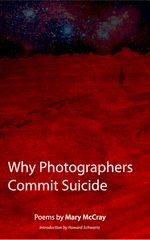
New Reviews for Why Photographers Commit Suicide

500x800I received a jacket blurb for my book of poems this spring from David H. Levy, the poetry-appreciating astronomer famous for his co-discovery in 1993 of Comet Shoemaker–Levy 9, which collided with the planet Jupiter in 1994. What a thrill this was… and so very appreciated:

"Remember when, in Carl Sagan's Contact, the main
character said "They should have sent a poet?"  Now we have. In a
skeptical age, it is extraordinary that we still have dreamers. Mary
McCray is one of the best and brightest.  From the great Tharsis volcano
on Mars to Olympus Mons, these poems are a celebration of what is best
about humanity's exploration of the planets. We are moving out among the
stars, and Mary McCray is leading us there."
–David H. Levy, astronomer and author of The Quest for Comets and David Levy's Guide to the Night Sky

I was on cloud nine I tell you!

Last week I also received a review in Savvy Verse & Wit. Excerpts from the review:

"These poems mesh not only the exploration of space with the modern world
here on Earth, but they also harken to older themes of Manifest Destiny
dating back to America’s youngest roots as a nation.  It’s a collection
about the opportunities space exploration can represent, which is
highly ironic given the government’s recent decision to shut down the
manned shuttle program…a reflection of space, and the amazing experience of “Sex in Zero
Gravity”: 

“astronaut, astronaut –/kiss me with your incomplete
sentences/and your raw relativity,/run your fingers like lasers,/escape
velocity through my motor heart,/the acceleration thrust/of your
deep-space Cadillac cruising/my jelly-fish tremors,/touching the
swirling hurricane/that is the red G-Spot of Jupiter/” 

There has never
been such a beautiful references to spaceships taking off and hurricanes
on foreign planets in poetry to describe a sexual encounter.

[The book] is imaginative and one of the best written science fiction collections
of poetry out there, and it will have readers questioning their place in
the world and the need to explore more."

Last week, the book also received a mixed review in Star*Line , the publication of The Science Fiction Poetry Association. Reviewer Susan Gabrielle felt I "offer some uniqueness of language and
lovely images" but she didn't respond to the humor in the book. Whereas Savvy Verse & Wit singled out the poem "Sex in Zero Gravity" as a "beautiful reflection of a sexual encounter," Gabrielle read that poem as satire and wanted me to deal with the book's "subject matter in a serious and sustained way."

I talked this over with my husband due to the fact that my poems are, to a large degree, humorous. I gravitate to the queer and comical take. How should I take this first not-so-hot review? Monsieur Big Bang surmises that science fiction poetry is struggling to be taken seriously right now and so they may not feel inclined to enjoy the kind of funny I do with space poems.

I'd love to hear from others about this. What is your take on humorous versus "sober" poetry? Especially in the context of space and science fiction themes?

To get a copy of the book, you can visit Amazon or Smashwords. It's available in paperback or eBook.


"Remember when, in Carl Sagan's Contact, the main
character said "They should have sent a poet?"  Now we have. In a
skeptical age, it is extraordinary that we still have dreamers. Mary
McCray is one of the best and brightest.  From the great Tharsis volcano
on Mars to Olympus Mons, these poems are a celebration of what is best
about humanity's exploration of the planets. We are moving out among the
stars, and Mary McCray is leading us there." 

—David H. Levy, astronomer and author of The Quest for Comets and David Levy's Guide to the Night Sky

5 Books About Writing in Forms

Although my journey in forms is far from complete, so far I have made it through five books on the subject. If you are new to this sort of thing, I find it helps to take these books in small chunks, go away for a while and come back later rather than be overwhelmed by this brave old nerdy world.

HandbookWhen I was an undergraduate at The University of Missouri-St. Louis, The Poet's Handbook by Judson Jerome (of Poet's Market) was our assigned reading for one of my workshops. We never got around to it and for years I let it linger on my bookshelf intimidated by its very cover. Years later, I gathered some stones and read the book. Was I wrong! This book was a gentle soul, easing me into the study of forms, starting from a look at free verses and the importance of the line.

Myself, I have never been able to keep the terms of scansion memorized, no matter how many of these books I read. Although I do feel I have the musical concepts solidly internalized from years of reading, writing and listening to music closely. But like any good mechanic, you only become more engaged with the tinkering you do when you learn how the car works.

That said, it is comforting when Jerome says, "It compounds frustration, if not confusion, to realize that neither Chaucer nor most of the poets who followed him up to modern times ever actually analyzed verse this way. They just wrote it with rather amazing metrical consistency, and these complicated adaptations of Classical metrical [scansion] terms have been introduced by prosadist to explain the phenomena of the poet's practice."

That's right! Poets didn't bother with bracketing out their lines with marks and numbers. And  scansion and metrics are not scientific laws. The whole "science" is rather inexact but better than nothing when it comes to studying a poem's engine. In fact, depending upon how you read a poem, there can be open controversy over whether a certain phrase is make up to be one antipast or an iamb next to a trochee. No one needs to get that crazy or snobbish about i.

The Poet's Handbook is an accessible textbook that covers most everything metrical including a healthy section on rhyme. However, there's not much on the popular forms like sonnets and sestinas.

RussellYears later I picked up this book at a library sale, Poetic Meter & Poetic Form by Paul Fussell. Both Jerome and Fussell make valiant cases for the use of forms, although Fussell is more dense and stuffy in his defense of why we need to care about music:

"…that regardless of the amount and quality of intellectual and emotional analysis that precedes poetic composition, in the moment of composition itself the poet is most conspicuously performing as a metrist."

Composition! Dear me. He can be a bit heavy handed as in, "Civilization is an impulse toward order."

Maybe true, Jack, but thousands of years of civilization hasn't made us all that civilized. But here is where my politics creep in. Unfortunately, a discussion on form invariably leads toward politics. Hippie liberals are free verse fanatics and conservatives are nostalgic for an era of Andy Griffith order that never was. Forms and free verse are like kids in a custody battle in the middle of it all.

I think young writers today are happily living with writing in a melding of both free verse and forms as they like, which is as it should be. Older folk still seem to have their axe to grind, (like the kind of "classical" poetry The New Criterion has been consistently whining for over the last decades). The establishment complains there is no variety or passion, specifically anger, in modern poetry, all while refusing to  acknowledge the very passionate and angry poets already out there. Is it a coincidence this poetry is being written by minorities and young women? When you dig beyond the common complaints and ailments, the bedrock is always political when it comes to free verse versus form.

Anyway, if you'd like something more advanced, this book is interesting for that and Russell focuses his study on metrical variation (how to set up an expectation in meter and then thwart it for effect) and like Jerome's book, there is a section on free verse and how it fits in. He makes an excellent point with:

"a free verse poem without dynamics…perceptible interesting movement from one given to another or without significant variations from some norm established by the texture of the poem… will risk the same sort of dullness as the metered poem which never varies from regularity…The principle is that every technical gesture in a poem must justify itself in meaning."

Russell also covers the sonnet extensively but not much on other popular forms like sestinas and pantoums.

This is surely your stuffy, highbrow choice.

ReasonI don't know where I picked up Rhyme's Reason by John Hollander but its best attribute is that it's skinny and concise, less than 100 pages. But the book covers verse systems, meters, free verse, "aberrant forms," and various popular forms such as odes, sestina, villanelles, etc. I like that it also covers rhetorical schemes such as the epic simile. It also has the best section on rhyme of the books here.

This is good for a fast breeze through all the basic concepts. Not much evangelizing which is always appreciated.


NewbookLewis Turco's The New Book of Forms was the popular must-have book on forms when I was at Sarah Lawrence College in the mid-1990s. Turco's divides his study on metrics into sections: the typographical, the sonic, the sensory and the ideational level. I found this organization to be elusive and confusing and I had more question marks by his text than in any other book. However, the real meat of this book is the last 175 pages which include an index of every form imaginable with examples.

I've used this book entirely as an invaluable encyclopedia of forms. But it's very lacking on the background behind those forms so it wont do on its own.

OdeThis is the book I just finished over the weekend, actor Stephen Fry's The  Ode Less Traveled, a book that was given to me by a friend. This one is an oddball in the set. Fry is both accessible and off-putting. He's upper crust British, a Shakespearean actor (which gives some perspective on blank verse), and he goes blue inexplicably in parts beyond the naughty limericks (which are great, btw). He's also a (very knowledgeable) layman attempting to teach to newbies. Experienced poets may have no patience for this. Because I like to re-visit subjects as a newbie occasionally (as Zen Buddhists instruct me to do), I found this refreshing. His book even includes lessons and tables. He's also good at bringing in pop culture examples (a gesure too lowbrow for the other books). I also appreciated he definition of what poets do, that we are concerned with precision, "exactly about the exact, fundamentally found in the fundamental, concretely concrete, radically rooted in the thisness and whatness of everything." Later he says, "Much of poetry is about consonance in the sense of correspondence: the likeness or congruity of one apparently disparate thng to another. Poetry is concerned with the connections between things."

But his attempts at humor often fell flat with me.Very flat. And of course he falls into the political pit, calling most contemporary poetry, "feeble-minded political correctness…it is if we have been encouraged to believe that form is a kind of fascism." WTF? He defines "free-form meanderings" as "prose therapy" and navel gazing. Hey, a form doesn't prevent one from navel gazing.  Then he goes on to say he is "far from contemptuous of Modernism and free verse" and he worries you'll think he's an "old dinosaur." Which I do BUT as my grandfather always said, you can learn something from anybody and I did enjoy this book overall. 

A good light choice for newbies and the eternal newbie.


Academic Book About Subversive Strategies in Women’s Poetry

YorkeLast week I finished Impertinent Voices, Subversive Strategies in Contemporary Women's Poetry, a book a found mucking around on Amazon.com. This is a very academic book, more about feminist theory than about poetic strategy. And definitely a book describing things as they were during the second wave of feminism. This book was published back in 1991, back when the media was saying young girls were in some kind of backlash against feminism (this was actually a Time Magazine cover story). This was before Riot Grrls and Bust Magazine and Bitch Magazine made third wave feminism relevant. So as a third waver myself, there were aspects of this book I found to be outdated. For instance, back when second wave was in its full throes, feminists felt that men still controlled the meanings of language and culture cues. Third wave feminists feel we have made inroads in this area (thanks to groundwork done by the second wavers, of course) and we feel more in control of our own labels, language and meanings. One example: women today would never think to describe a woman who is assertive or angry or pushing boundaries as "impertinent" because we don't accept that what she is doing is rude or inappropriate by definition. She is telling it like it is. Screw impertinence.

That generation-gap aside, this book did some good things for me. This book opened me up (finally!) to Sylvia Plath. There are about three chapters devoted to her struggles and strategies in this book. If you have trouble connecting with Plath, as I have over the years, this book might help.

The book also has chapters devoted to Adrienne Rich, H.D., and Audrey Lorde.


Pitt Poetry Series Catalog 2013

CatalogMonths and months ago I received this catalog in the mail and haven't had time to discuss it. I love getting these catalogs. They're full of free sample poems from new poets and I actually do buy books from them. I've tagged the following poets and books for checking out:

Daisy Fried's Women's Poetry (gritty poem here about women's poetry mashed-up with car parts), Denise Duhamel's Blowout (I always love her frank poems), Laura Read's Instructions for My Mother's Funeral (seems poingnant to me now that my Aunt Merle has just passed away), Paisley Rekdal's book Animal Eye looks good (she does a poem about the movie The Fly called "Intimacy").

The poem "Getting Down With the Mofos" by Elton Glaser was some sing-songy childlike language/ars poetica poetry. Alicia Suskin Ostriker's poem "Fire" is a great fire and brimstone piece. And I liked these lines from Jan Beatty's poem, "Visitation at Gogama:"

I saw my birth father young and alive,
he stepped out of a brown house with a white
sign on the side: WILD BILL (his nickname)
in big block letters. I saw him the way he was
before he made me.


A Book About Childhood

IhwBack in 2004, Timberline Press, a handpress of books published by Clarence Wolfshohl, produced a book of my hauku (co-written by Julie Wiskirchen). Clarence also designed four zinc-cuts illustrations in the book. 

So I was delighted to see news that Clarence and his friend Mark Vinz are putting out a new handmade book on the El Grito del Lobo Press. In Harm's Way are their dueling poems about quite different childhoods, Clarence's in San Antonio, Texas, and Mark's in Minneapolis, Minnesota.

The poems almost read like little short stories narratives about doctors and childhood scabs, theology with a kid POV, teachers, grandparents, baseball and baseball cards, movies, food, learning to drive and a marvelous marble poems ("the one that rolled away") by Mark Vinz. Never knowing Clarence Wolfshohl grew up in Texas, I was pleasantly drawn to his poems that reflected a similar childhood to my early years in New Mexico, his talk of horned toads (we called them horney toads and tried to move a family of them out to the humid Missouri climate in 1977 where they all tragically died), his mention of caliche (who knows caliche outside of the southwest?) and Tex Ritter (my Dad loved "Blood on the Saddle" much more than I did hearing it decades later). I loved Clarence's poem about western idols, "Gunfight at the RKO Corral." I also loved his poem about Mexican food, "Starched in the Barrio." His poem "Under the Bridge" was also a good reflection on childhood imagination appreciating those who came before, petroglyphs under a bridge that:

amazed us, not as archaeologists
first led to Lascaux, but as a wandering tribe
alert we were not the first in this territory.

I also thought Clarence's graphic rabbit-hunting poem, "The Last Hunt," was somewhat chilling. Mark and Clarence both had strong learning to drive poems to end the book, Mark's description of his transcendent love for bumper cars:

All that mattered was racing toward
some car-free outer lane, where I
could circle, endlessly, lost to myself
and the road–all those years and miles
I was suddenly certain were coming.

This letterpress, hand-bound book also has two serigraph illustrations in the middle of the book depicting the poets as young innocents. To order, send $20.00 (postage paid) to:

Clarence Wolfshohl
6281 Red Bud
Fulton, Missouri 65251

Make checks payable to Clarence Wolfshohl. As Mark Vinz says in the introduction, (just like a Norwegian Minnesotan), this collection is "Quite the deal!"


« Older posts Newer posts »

© 2026 Big Bang Poetry

Theme by Anders NorenUp ↑